
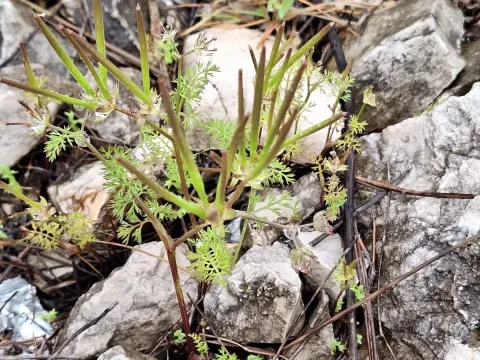
Scandix australis
Scandix australis
Scandix australis is an annual herbaceous plant typically sown in early spring as soon as soil temperatures allow for active germination.
What the section contains
Scandix australis
The seeds may require a period of stratification or cool treatment to break dormancy and ensure a uniform emergence of seedlings in the field.
Seeds should be planted at a shallow depth of 1-2 centimeters in well-prepared, friable soil to facilitate easier emergence of the small sprouts.
Row spacing should be maintained between 25 and 30 centimeters, which allows for mechanical weed control and ensures adequate space for each plant.
In regions with mild winters, autumn or winter sowing can be practiced to take advantage of soil moisture and promote early spring growth.
Belonging to the Apiaceae family, Scandix australis thrives in sunny locations with well-drained, fertile soils that are rich in organic matter.
The plant is sensitive to excessive heat, which can trigger early bolting, so it is best cultivated in temperate climate conditions with sufficient light.
Consistent moisture is necessary throughout the early stages of development, though the soil must not remain waterlogged to prevent root health issues.
Neutral or slightly alkaline pH levels in the soil are ideal, as these conditions favor the optimal nutrient uptake for the development of leafy greens.
Good air circulation is essential for this species to maintain plant health and prevent the buildup of humidity around the leaf rosettes.
The yield of Scandix australis consists primarily of fresh leaves, which are harvested before the plant transitions into its reproductive flowering phase.
Under optimal growth conditions, growers can achieve a consistent supply of aromatic leaves, making it a valuable specialty crop for market gardeners.
Yield efficiency is maximized through regular irrigation and the removal of competing weeds that might otherwise rob the crop of essential nutrients.
Once the plant begins to produce a flower stalk, the vegetative growth slows down, significantly reducing the quantity and quality of the harvestable foliage.
For seed production, yield is measured by the number of fruit pods produced per plant, requiring careful monitoring to avoid pre-harvest shattering.
The crop is susceptible to common garden pests such as aphids, which tend to congregate on the tender leaves and stems during warmer months.
Fungal pathogens like powdery mildew can infect the plants if they are grown in overcrowded conditions with poor airflow or high humidity.
Soil-borne pests and nematodes can sometimes cause root damage, leading to stunted growth and yellowing of the foliage across the entire patch.
Effective management includes implementing crop rotation and avoiding planting near other Apiaceae members to minimize the spread of specific diseases.
Integrated pest management strategies are encouraged to protect the quality of the greens, focusing on preventative rather than reactive measures.
Harvesting should occur when the plants have reached full rosette size but before any signs of stem elongation or flowering are present.
Using sharp, clean shears allows for a precise cut at the base of the plant, which helps keep the harvested product clean and uniform.
Morning harvesting is highly recommended, as the leaves are turgid and contain the highest concentration of volatile aromatic compounds at this time.
Post-harvest handling involves immediate cooling to preserve the crisp texture and fresh flavor profile of the leaves for the consumer market.
If the plants are intended for seed harvesting, wait until the fruits have fully developed and turned brown, then collect them before they disperse.