
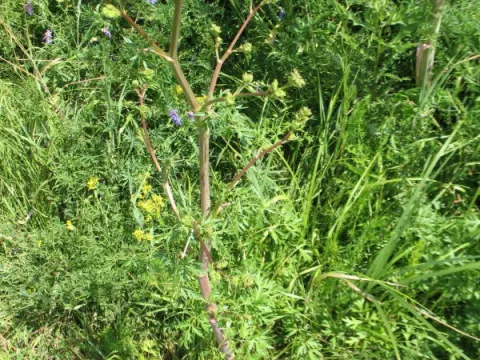
Alsatian masterwort
Peucedanum alsaticum
Sowing seeds of Alsatian masterwort is best done in late autumn as a winter crop, since the seeds require natural stratification in the soil to ensure uniform germination in the spring.
What the section contains
Alsatian masterwort
In commercial farming, early spring sowing is also practiced, but in this case, it is necessary to provide preliminary stratification of the seed material at a temperature of 0 to 5 degrees Celsius for 1–2 months.
The depth of sowing should not exceed 1–2 centimeters, which is due to the small size of the seeds and the seedlings' need for sufficient light for successful root establishment.
Row spacing during sowing is set within 45–60 centimeters, ensuring an optimal feeding area for the development of the perennial plant's strong root system.
During the first year of life, the crop develops slowly, forming mainly a basal rosette of leaves, so regular weed control during the early stages of vegetation is an important agronomic practice.
Alsatian masterwort belongs to the Apiaceae family and prefers open, well-lit areas, as the plant is highly photophilous and tolerates even slight shading poorly.
The crop has moderate soil requirements; it grows best on sandy loam or light loamy soils with good drainage and a soil reaction close to neutral.
The plant possesses high drought resistance, allowing it to be successfully cultivated in regions with insufficient moisture, where other fodder or medicinal herbs show low productivity.
In regions with harsh winters, Alsatian masterwort shows sufficient winter hardiness, and its rhizomes can withstand significant soil freezing without the risk of winterkill.
An important requirement is the absence of stagnant groundwater, as excessive moisture in the autumn-winter period can lead to the damping off of the root collar and the development of root rots.
The green mass yield of Alsatian masterwort depends significantly on the age of the plantation and the agronomic background, reaching its peak in the second and third years of the plant's life.
During the flowering phase, the plant accumulates the largest amount of biologically active substances, making this period the most significant for harvesting medicinal raw materials.
When used as a fodder crop, the yield can range from 1.5 to 2.5 tonnes of dry mass per hectare, provided that the optimal plant density is maintained.
Seed yield for cultivation purposes varies depending on meteorological conditions during the flowering period and the activity of pollinating insects.
Effective yield management requires regular application of mineral fertilizers, especially phosphorus-potassium compounds, which stimulate the development of reproductive organs and roots.
The main pests for Alsatian masterwort are members of the Apiaceae pest family, such as the parsnip moth, whose larvae can damage flower stalks and leaves.
Under conditions of high humidity, the plant may be affected by powdery mildew, which manifests as the formation of a whitish coating on the leaf blades and a slowdown in growth rates.
Root rots caused by soil-borne fungi pose a serious danger if the soil water regime is disturbed and the root system lacks aeration.
Aphids can infest young inflorescences by sucking cell sap, leading to shoot deformation and a significant decrease in seed productivity.
To prevent the spread of diseases and pests, compliance with crop rotation and timely removal of plant residues, which can be a source of infection, is recommended.
Harvesting the aerial part (herb) is carried out during the mass flowering phase, when the concentration of essential oils and coumarins in the plant tissues reaches its peak values.
Raw material collection should be carried out in dry, sunny weather, as the presence of moisture on the leaf surface significantly complicates subsequent drying and reduces the quality of the final product.
When harvesting seeds, collection begins when the umbels turn brown, using a split harvesting method to minimize losses from shattering during over-ripening.
Rhizomes, if they are the object of collection, are dug up in autumn at the end of the growing season, when nutrients move from the leaves to the underground part of the plant.
After harvesting, the raw material is subjected to forced drying at a temperature not exceeding 40–45 degrees Celsius to preserve aromatic properties and active chemical components.