
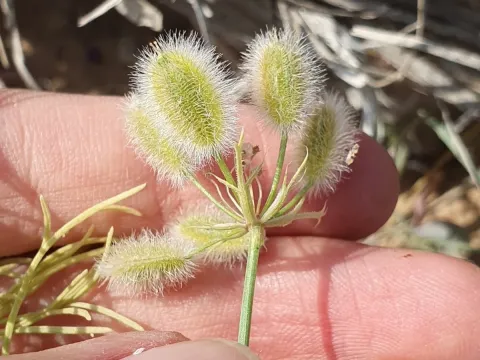
Ammodaucus
Ammodaucus
Ammodaucus is an annual herbaceous plant belonging to the Apiaceae (parsley) family. Naturally occurring in arid regions of North Africa, it is uniquely adapted to thrive in sandy and stony soils under harsh environmental conditions. Its biology is centered on survival in desert-like landscapes.
What the section contains

Ammodaucus
For cultivation, seeds should be sown in early spring as soon as the soil temperatures are consistently favorable. The plant requires maximum solar exposure, so selecting a location with full sun is vital for healthy growth and development. Any shading will negatively impact the plant's metabolic processes.
The seeds should be planted at a shallow depth of 1-2 centimeters. A light, well-draining soil structure is essential; sandy-loam compositions are ideal. Because the seeds are small, precise planting depth is necessary to ensure successful germination without burying them too deeply.
Adequate moisture is required only during the germination phase. Once established, Ammodaucus is highly drought-tolerant. Over-watering, especially in the later stages, can lead to root degradation and hinder the development of the primary taproot.
Space the plants adequately to allow for air circulation, which is crucial for preventing fungal issues. The plant develops a deep taproot system, making it highly efficient at utilizing subsurface water, but it dislikes root disturbance during growth.
This crop thrives in warm climates, ideally within a temperature range of 22 to 30 degrees Celsius. It is highly resistant to heat waves, which are characteristic of its native habitat, making it a potentially valuable crop for very hot, arid agricultural zones.
Soil requirements focus on aeration and drainage. Ammodaucus does not tolerate heavy, waterlogged, or clay-heavy soils. A neutral to slightly alkaline pH is preferable for optimal nutrient uptake, which facilitates the synthesis of essential oils in the seeds.
Fertilization should be moderate. While phosphorus and potassium applications can boost fruit development and oil concentration, nitrogen must be used sparingly. Excessive nitrogen leads to rampant vegetative growth, which may decrease the overall seed yield.
The plant demands a clean, weed-free environment. Early-stage weed competition is devastating to Ammodaucus due to its slow initial growth rate. Regular inter-row cultivation is required to keep the surface loose, which helps manage soil moisture and oxygen levels.
Good ventilation is a non-negotiable requirement. The microclimate around the plants should remain dry, especially during the flowering and seed-set phases. Humidity levels should be monitored to prevent the onset of common Apiaceae diseases.
Common pests include aphids, which frequently target the soft, growing tips of the plants. If left unchecked, aphids can cause severe stunting and may transmit viruses, which are particularly damaging to annual crops like Ammodaucus.
Diseases such as powdery mildew are the primary concern in humid conditions. Poor airflow around the plant canopy encourages fungal growth, which can quickly spread across the field, leading to leaf drop and reduced seed quality.
Integrated pest management is recommended over the use of harsh synthetic pesticides. Biological controls, such as beneficial predatory insects, should be used whenever possible to protect the crop's integrity, particularly if the seeds are intended for food or pharmaceutical use.
Crop rotation is essential for disease prevention. Ammodaucus should not be grown on the same land for several years, especially if other Umbellifers were recently cultivated there, to avoid the buildup of soil-borne pathogens and specific nematodes.
Removing plant debris after harvest is a standard sanitary procedure. Many pathogens survive on stems and leaves during the off-season, so field sanitation helps significantly in reducing the infection pressure for the next season.
The harvest phase occurs when the seeds reach full physiological maturity. This is indicated by the transition of the umbels from a green or light color to a rich brown, signaling that the plant's life cycle is complete and the nutrients are concentrated in the seeds.
For best results, harvest should take place in the early morning. This timing ensures that the seed moisture content is low and the essential oils, which are volatile, are at their most concentrated levels within the plant tissues.
Once harvested, the plant material must be dried immediately in a shaded, well-ventilated area. Direct sunlight during the drying process will degrade the aromatic compounds, which significantly reduces the economic value of the seed crop.
Threshing should be performed gently once the material is brittle and dry. After threshing, the seeds need careful cleaning to remove chaff and debris, ensuring a high-quality, pure product that meets industry standards for aromatic seeds.
Storage is the final step in maintaining quality. Seeds must be kept in airtight containers in a cool, dry place. Proper storage prevents moisture regain and protects the seeds from oxidation, preserving their potent medicinal and culinary properties.