
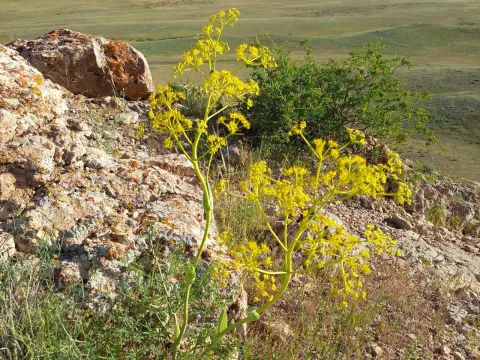
Sheep Ferula
Ferula ovina
Sowing of Ferula ovina is mainly carried out in the autumn, before winter, which provides natural stratification of the seeds. Early spring sowing is also possible, but it requires preliminary preparation of the seed material for 30–60 days at low positive temperatures.
What the section contains
Sheep Ferula
The sowing depth is 1.5–2 cm. Under intensive grazing conditions, a row-sowing method with row spacing up to 45 cm is recommended to prevent heavy weed competition during the initial stages of development.
Seedlings emerge slowly, making the absence of weed competition during the first year of vegetation extremely important. The crop is characterized by weak growth in the first season, forming only a rosette of basal leaves.
To improve germination on large areas, soil harrowing is carried out immediately after sowing to ensure optimal contact between the seeds and the moist substrate.
The optimal seeding rate is about 4–6 kg per hectare, provided the seeds have high germination capacity, though due to their biological characteristics, higher rates are often used to compensate for uneven emergence.
Sheep Ferula is a typical xerophyte belonging to the Apiaceae family. The plant is perfectly adapted to the semi-desert and dry steppe conditions of Central Asia, where it is an important component of the natural grasslands.
The crop is extremely light-demanding and does not tolerate even slight shading. It prefers open, well-ventilated areas with low air humidity.
Soil preferences include light loamy or sandy soils with good water permeability. The plant does not tolerate stagnant groundwater or high moisture levels in the root zone.
Ferula exhibits phenomenal drought resistance, making it promising for the improvement of degraded pastures in regions with arid climates. It successfully survives the sharp temperature fluctuations typical of a continental climate.
The plant is relatively undemanding regarding soil fertility, but it responds well to the application of phosphorus fertilizers during the initial growth period, which facilitates the development of a powerful root system.
The main danger to the crop comes from pests specific to the Apiaceae family. Specifically, various types of bugs and weevils damage the inflorescences and reduce seed productivity.
In years with high humidity, fungal diseases such as powdery mildew or gray rot of the root crown can develop in the stands, which often happens when planting density norms are violated.
The root system of Ferula is susceptible to soil-borne pests, such as click beetle larvae (wireworms), especially in fields recently reclaimed from virgin lands.
To control diseases, crop rotation is recommended, along with the timely removal of plant residues, which can harbor infection pathogens during the winter period.
The use of chemical protection agents must be strictly limited as the plant is frequently used for livestock grazing, requiring strict adherence to waiting periods after pesticide application.
The economic use of Ferula ovina is primarily aimed at livestock grazing, particularly for sheep, for whom it serves as a valuable early spring forage. Its use for hay production is limited due to the high content of essential oils in the plant's tissues.
Seed harvesting for reproduction is carried out during the phase of full maturity, when the umbels turn a characteristic brown color. It is important to harvest promptly, as the seeds are prone to shedding quickly in strong winds.
Drying of the seed material is done in the shade with active ventilation to avoid spoilage and to maintain the high germination energy characteristic of the species.
To increase pasture productivity, controlled grazing is used, preventing the overgrazing of plants to the base during the generative shoot formation period to ensure natural population recovery.
When using the plant as a raw material for pharmacology, harvesting is conducted during the flowering phase, when the concentration of biologically active substances in the plant organs reaches its maximum.