
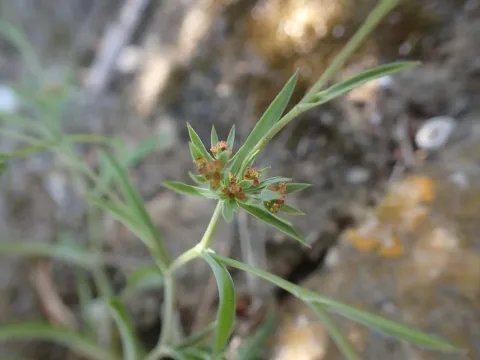
Semicomposite hare's ear
Bupleurum semicompositum
Bupleurum semicompositum, commonly known as the semicomposite hare's ear, is an annual herbaceous plant belonging to the Apiaceae family. It is a highly specialized species adapted to survive in harsh, arid Mediterranean-type climates.
What the section contains
Semicomposite hare's ear
This species is native to the Mediterranean basin, North Africa, and parts of the Middle East. It typically colonizes rocky hillsides, sandy substrates, and coastal dunes, thriving where most other vegetation struggles to establish.
The botanical structure is marked by thin, branching stems and narrow leaves that often exhibit a glaucous, bluish-green appearance. The flowers are arranged in small, dense compound umbels, which serve as an efficient reproductive mechanism in open, sunny environments.
Regarding soil and climate, the plant requires excellent drainage and full sun exposure. It is highly resistant to drought and can tolerate poor, alkaline, or slightly saline soils, making it an ecologically significant pioneer plant in degraded lands.
In terms of agricultural and research potential, the plant is studied for its chemical profile, particularly the presence of specific terpenoids and flavonoids. While not a commercial crop, its biological resilience offers insights into plant physiology under stress conditions.
Pathogenic fungi, particularly powdery mildew (Erysiphe species), can infect the foliage during humid spring seasons, potentially hindering the development of the plant and its seed set.
Herbivorous insects, such as aphids and larvae of various dipteran species, may feed on the delicate umbels. Because it grows primarily in non-managed habitats, these threats typically fluctuate based on natural ecosystem dynamics.