
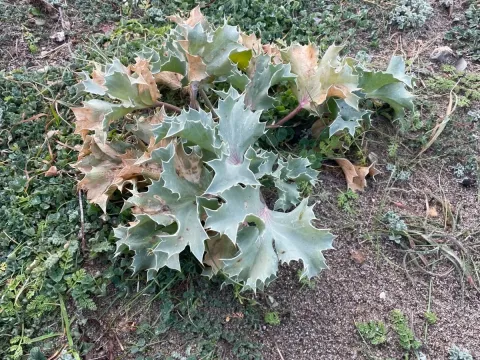
Sea holly
Eryngium maritimum
Sea holly is primarily propagated by seeds, as well as vegetatively by division. The seeds require stratification to ensure successful germination, making late autumn the ideal time for sowing directly into open soil.
What the section contains
Sea holly
For spring sowing, seeds are placed in trays during March, ensuring they undergo a cold pre-treatment at 2–4 degrees Celsius for at least one month. Seeds should be sown at a depth of 0.5–1 cm, maintaining spacing between rows to provide adequate sunlight for the seedlings.
It is important to note that the plant develops a deep taproot system, so transplantation should be performed only at the juvenile leaf stage. The plant does not tolerate root disturbance well, which must be considered when designing the planting scheme for its permanent location.
The optimal temperature for uniform germination is 18–20 degrees Celsius with moderate moisture. Once the first pair of true leaves appears, the seedlings should be gradually hardened off to outdoor conditions over a period of 10–14 days.
Seedlings are transplanted to their permanent site using a spacing of 40 by 40 centimeters, as mature sea holly plants occupy a significant area and require ample space for the full development of their leaf rosettes.
Sea holly (Eryngium maritimum) is a perennial herbaceous plant from the Apiaceae family, naturally adapted to the harsh conditions of sandy coastal environments. It is highly resistant to soil salinity and strong winds.
The crop prefers well-drained, loose, and sandy soils with low organic content. Waterlogging is fatal to this species, so in heavy clay soils, it is mandatory to create a high drainage layer of gravel or coarse sand.
This plant is light-loving; therefore, to thrive and acquire its characteristic silvery-blue hue, it requires an open, sunny location. In shade, sea holly tends to become leggy, loses its ornamental value, and becomes susceptible to fungal diseases.
The crop shows remarkable resilience to climatic conditions, easily enduring long periods of drought due to the structure of its leaves, which are covered in a protective waxy bloom. The optimal soil pH for this plant ranges from slightly alkaline to neutral.
During cultivation, it is essential to avoid excessive nitrogen fertilization, as this encourages excessive vegetative growth at the expense of flowering. Mineral complexes designed for succulents or wood ash are recommended as effective fertilizers.
Typical threats to sea holly are related to moisture management issues. Excessive soil moisture during the autumn and winter periods often leads to collar rot, which represents a critical risk for this specific plant species.
Among pests, aphids pose the greatest danger, as they colonize the inflorescences and young shoots during the active growing season. Upon detection of early infestation, treatment with systemic insecticides or insecticidal soaps is recommended.
Fungal infections, such as leaf spot and powdery mildew, may develop under conditions of high air humidity and poor air circulation. Prevention involves strictly maintaining proper spacing between plants and consistently removing weeds.
Root rots, caused by various pathogenic fungi (such as Pythium), affect the plant when grown in heavy, compacted soil. Disease development can be mitigated by applying fungicidal agents into planting holes during the early stages.
During drought, infestations of spider mites are possible, especially if the plant is weakened by unfavorable environmental factors. To manage these pests, acaricides should be used, ensuring thorough coverage of the underside of the leaf blades.