
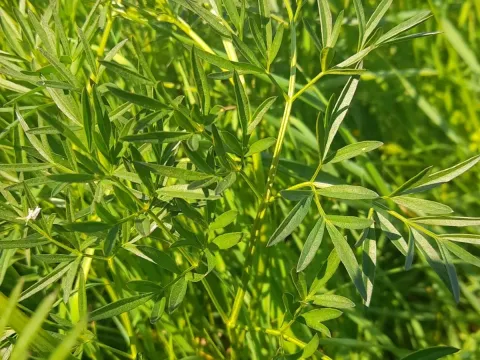
Silaum
Silaum
Silaum is a genus of perennial herbaceous plants belonging to the Apiaceae family. In agricultural settings, it is primarily managed as a component of permanent meadows and pastures rather than as a primary crop.
What the section contains

Silaum
Sowing is typically performed during late autumn or early spring, as the seeds require a period of stratification to achieve successful germination.
When renovating grasslands, Silaum seeds are often broadcast as part of a seed mixture alongside various perennial grasses and legumes to enhance forage quality.
The optimal seeding depth is shallow, ranging from 1 to 2 centimeters, as the small seeds require adequate light penetration to germinate effectively.
The plant exhibits slow establishment during the first year, focusing primarily on root development and the production of a basal leaf rosette.
The plant thrives in moist, fertile loam or clay soils and is commonly found in natural meadows across Europe and Western Asia where groundwater levels are sufficient.
Silaum exhibits high winter hardiness, allowing it to persist in regions with severe winters and significant seasonal temperature fluctuations.
It prefers sunny locations, as excessive shading from trees or dense vegetation significantly reduces its growth rate and overall plant vigor.
Stable soil moisture is crucial for its development; prolonged droughts can lead to premature yellowing of the foliage and significant growth suppression.
The preferred soil reaction for this culture ranges from slightly acidic to neutral, which supports optimal nutrient availability for sustained growth.
The main agricultural utility of Silaum is the production of green biomass, which serves as a valuable forage source for livestock.
Yield potential fluctuates depending on the composition of the meadow; typically, it produces between 1.5 and 3.0 metric tons of dry matter per hectare.
The nutritional value peaks during the budding phase and the onset of flowering, making this the ideal time for forage harvesting.
It displays a moderate capacity for regrowth after mowing, allowing for one or two harvests per season under favorable moisture conditions.
When used for grazing, rotational management is essential to prevent overgrazing and maintain the long-term presence of the plant within the pasture.
The culture is generally resilient, but in poorly drained or overly humid conditions, it may become susceptible to powdery mildew infections.
Common insect pests include specific species of bugs and aphids that target the developing flower umbels and succulent young stems.
Improper harvesting regimes, such as cutting too frequently or too low to the ground, can weaken the root system and leave the plant prone to decay.
Protection of seed crops often requires careful monitoring and the application of pest control measures during the flowering and seed-set stages.
- Maintaining proper drainage to prevent root and stem rot.
- Regular inspection for aphid clusters on flowering umbels.
Harvesting for hay is most effective at full bloom, as this captures the best balance between biomass yield and crude protein content.
During the drying process, it is vital to handle the cut material gently to prevent the loss of foliage, which is the most nutrient-dense part of the plant.
Seed production involves cutting the umbels once they have turned brown, followed by a period of field drying or indoor conditioning before threshing.
Post-harvest seed processing should involve cleaning and storage in a cool, dry environment to maintain high germination rates for future planting.
The remaining biomass can be integrated back into the nutrient cycle or utilized as supplementary fodder depending on local farm practices.