
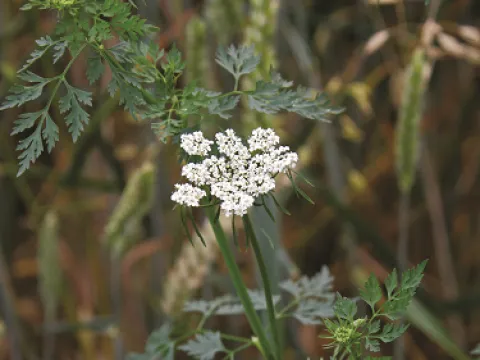
Fool's parsley
Aethusa
Fool's parsley (Aethusa cynapium) is an annual or biennial herbaceous plant belonging to the Apiaceae (carrot) family. In agricultural production, it is strictly considered an invasive weed rather than a cultivated crop, often infesting cereal and vegetable fields.
What the section contains

Fool's parsley
Propagation is exclusively through seeds. The germination period is extended, with seedlings emerging throughout the entire growing season, starting from early spring and continuing into late autumn.
The plant demonstrates a rapid growth cycle in the rosette stage. Autumn-emerging seedlings are particularly persistent, surviving winter temperatures and resuming vigorous growth early in the spring season.
Its biological life cycle is highly adapted to temperate climates. Seeds begin to germinate at soil temperatures between +3 and +6 degrees Celsius, allowing the weed to establish itself alongside early-sown agricultural crops.
The longevity of its seeds in the soil, which can remain viable for over 5–10 years, makes it a resilient opponent that requires long-term management strategies in any crop protection program.
This species thrives in fertile, moist soils rich in nitrogen. It shows a particular preference for loamy and clay-heavy soils, which are commonly found in regions with intensive farming activities.
Aethusa cynapium displays ecological flexibility regarding light conditions. While it prefers partial shade, it is perfectly capable of developing in open, sun-exposed fields provided there is sufficient moisture.
Soil pH plays a critical role in the distribution of this plant. It prefers neutral to slightly alkaline environments and is less frequently encountered in highly acidic soil conditions, making it an informal indicator of soil health.
The plant possesses a robust taproot system that allows it to withstand short-term drought periods by accessing deeper moisture reserves in the soil profile.
In high-density crop systems, it acts as a strong competitor for essential nutrients, causing significant reductions in crop yields if left uncontrolled, especially in vegetable production.
Fool's parsley is susceptible to common diseases affecting the Apiaceae family, including powdery mildew and various types of rust. These diseases can easily spread from the weed to adjacent commercial crops in humid conditions.
Pests such as aphids are frequently found on its stems and leaves, extracting nutrients and potentially spreading viral pathogens that can affect both the weed and nearby cultivated crops.
The most significant threat is its high toxicity to livestock. Containing alkaloids such as coniine and cynapine, the plant remains dangerous even when dried in hay, posing a lethal threat to grazing animals and fodder quality.
Effective management requires a combination of mechanical and chemical methods, as the plant's morphological resemblance to parsley or young carrots can complicate manual weeding and selective herbicide application.
- Regular discing or hoeing before the plant reaches the flowering stage.
- Use of selective herbicides during the early seedling stage.
- Implementation of crop rotation including broad-leaf control measures.
- Maintaining high seed purity to prevent field infestation.