
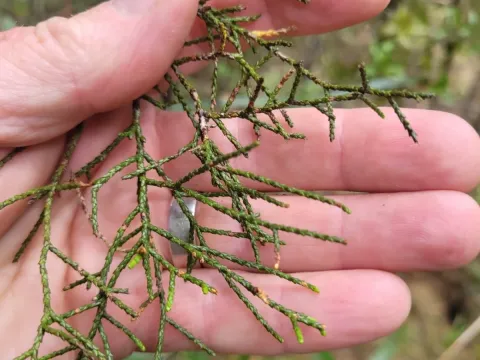
Dacrydium colensoi
Dacrydium colensoi Hook.
Dacrydium colensoi, commonly known in its native New Zealand as silver pine, is an evergreen conifer belonging to the family Podocarpaceae. It is a slow-growing, resilient species native to the temperate rainforests of the North and South Islands.
What the section contains
Dacrydium colensoi
The plant thrives in cool, humid environments with consistent rainfall. It is not cold-hardy in extremely harsh climates and generally requires sheltered conditions to prevent frost damage to the delicate new growth during the spring season.
Regarding soil requirements, this culture demands well-drained, acidic soil rich in organic matter. It is naturally adapted to poor, boggy soils in some parts of its habitat, but in a cultivated setting, excellent drainage is mandatory to prevent root rot.
The botanical structure is unique, featuring a transition from needle-like juvenile foliage to small, scale-like leaves on mature branches. This transformation is a signature characteristic of its development throughout its long lifespan.
Agrotechnical management focuses primarily on maintaining moisture levels. Mulching with acidic pine bark or needles is recommended to suppress weeds and stabilize soil temperature, as the shallow root system is sensitive to rapid thermal changes.
The culture is susceptible to standard coniferous pathogens, particularly fungal infections such as Phytophthora, which are common in waterlogged or poorly ventilated conditions. Prevention through proper spacing and drainage is the most effective control method.
Pests are generally limited, but scale insects or spider mites may attack the foliage if the air becomes too dry for extended periods. Regular inspection of the undersides of branches is advised to catch early infestations.
Environmental stress is a greater threat than diseases. Sudden exposure to high heat or dry winds can cause rapid desiccation, leading to foliage drop and potential dieback of the apical meristem.
Integrated pest management (IPM) should be prioritized. Biological control agents are preferred over chemical pesticides, as the delicate foliage of the silver pine can be sensitive to heavy synthetic formulations.
Proper airflow is critical. Ensuring that the tree is not overcrowded by other vegetation helps reduce the humidity traps that facilitate the development of fungal spores and other opportunistic plant pathogens.