
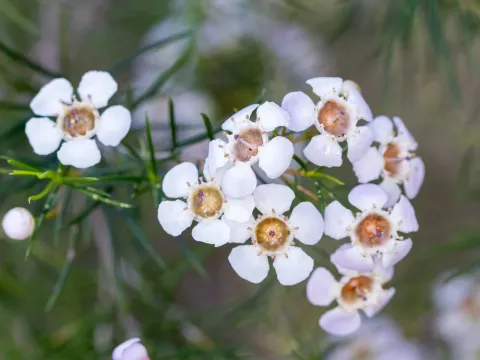
Chamelaucium
Chamelaucium Desf.
Chamelaucium (Chamelaucium Desf.) belongs to the Myrtaceae family. It is an evergreen shrub native to the sandy and rocky soils of Western Australia.
What the section contains
 Chamelaucium axillare
Chamelaucium axillare
Chamelaucium axillare
 Chamelaucium axillare x uncinatum
Chamelaucium axillare x uncinatum
Chamelaucium axillare x uncinatum
 Chamelaucium ciliatum
 Desf.
Chamelaucium ciliatum
Chamelaucium ciliatum Desf.
 Chamelaucium floriferum
Chamelaucium floriferum
Chamelaucium floriferum
 Chamelaucium forestii
Chamelaucium forestii
Chamelaucium forestii
 Chamelaucium hybrids
Hybrids between Chamelaucium uncinatum and Chamelaucium megalopetalum
Chamelaucium hybrids
Hybrids between Chamelaucium uncinatum and Chamelaucium megalopetalum
 Chamelaucium hybrids
Hybrids between Chamelaucium uncinatum Schauer and Chamelaucium micranthum (Turcz.) Domin
Chamelaucium hybrids
Hybrids between Chamelaucium uncinatum Schauer and Chamelaucium micranthum (Turcz.) Domin
 Chamelaucium megalopetalum
 F. Muell. ex Benth
Chamelaucium megalopetalum
Chamelaucium megalopetalum F. Muell. ex Benth
 Chamelaucium micranthum
Chamelaucium micranthum
Chamelaucium micranthum
 Geraldton wax
Chamelaucium uncinatum x forestii
Geraldton wax
Chamelaucium uncinatum x forestii
 Geraldton wax
Chamelaucium uncinatum Schauer
Hybrid Waxflower
Chamelaucium floriferum x uncinatum
Geraldton wax
Chamelaucium uncinatum Schauer
Hybrid Waxflower
Chamelaucium floriferum x uncinatum
Chamelaucium
The crop is highly light-demanding: full sun exposure throughout the day is essential for vigorous growth and abundant flowering. In greenhouse or open-field conditions, ensuring proper air circulation is critical, as stagnant humid air leads to fungal diseases.
The plant prefers light, well-drained substrates with low nutrient concentrations. Waterlogging of the root system is fatal to Chamelaucium, so the soil pH should be slightly acidic to neutral.
The optimal growing temperature ranges from 15 to 25 degrees Celsius. Chamelaucium does not tolerate freezing temperatures, which is why in temperate regions it is mainly grown in protected environments or as a container plant.
Agrotechnical practices include moderate irrigation with soft water and regular pruning after flowering. Pruning stimulates branching and helps shape a compact canopy, which significantly enhances the commercial value of the ornamental shrub.
The primary pests affecting Chamelaucium are spider mites and mealybugs, which thrive in conditions of low humidity and high temperatures.
Root rots caused by Phytophthora pathogens pose the greatest threat to commercial plantations. Disease development is usually triggered by soil over-saturation and poor drainage systems.
For pest prevention, regular inspection of the underside of leaves and the application of systemic insecticides at the first sign of infestation are highly recommended.
Bacterial leaf spots may occur due to improper greenhouse ventilation, requiring the immediate removal and disposal of affected plant parts.
Adhering to strict phytosanitary standards and ensuring the quality of propagating material are crucial protection measures that minimize the need for pesticides during the cultivation cycle.
Chamelaucium is primarily cultivated as a cut flower crop for the floristry industry. The harvest period coincides with the phase of full bloom when the petals acquire their signature waxy texture.
Shoots are harvested using sharp tools during the early morning hours when the plant is at its maximum moisture content. The length of the harvested stems depends on variety-specific traits and market requirements.
Post-harvest, the stems must be placed immediately into water treated with floral preservatives to prevent bacterial growth within the xylem vessels.
Product transportation is carried out at low temperatures to maintain the turgor of leaves and inflorescences until the product reaches the final consumer.
Standardization involves grading the branches based on length, flower density, and the absence of mechanical damage to ensure high market value per unit.