
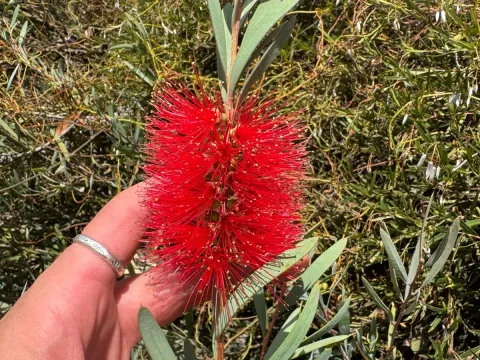
Callistemon
Callistemon R. Br.
Callistemon R. Br., commonly known as bottlebrush, is a genus of shrubs and trees belonging to the Myrtaceae family. Native to Australia, these plants are highly adapted to various environments, ranging from wetland areas to rocky slopes in arid regions.
What the section contains
 Callistemon glaucus
 (Bonpl.) Sweet
Callistemon glaucus
Callistemon glaucus (Bonpl.) Sweet
 Callistemon recurvus
 R.D.Spencer & Lumley
Callistemon recurvus
Callistemon recurvus R.D.Spencer & Lumley
 Callistemon viminalis
 (Sol. ex Gaertn.) G. Don
Callistemon viminalis
Callistemon viminalis (Sol. ex Gaertn.) G. Don
 Crimson bottlebrush
Callistemon citrinus (Curtis) Skeels
Crimson bottlebrush
Callistemon citrinus (Curtis) Skeels
 Crimson bottlebrush
Callistemon pallidus x Callistemon citrinus
Lemon Bottlebrush
Callistemon pallidus (Bonpl.) DC.
Crimson bottlebrush
Callistemon pallidus x Callistemon citrinus
Lemon Bottlebrush
Callistemon pallidus (Bonpl.) DC.
 Lesser Bottlebrush
Callistemon phoeniceus Lindl.
Lesser Bottlebrush
Callistemon phoeniceus Lindl.
 White bottlebrush
Callistemon salignus (Sm.) Sweet
White bottlebrush
Callistemon salignus (Sm.) Sweet
Callistemon
The botanical highlight of this culture is its unique inflorescences, which consist of long, colorful stamens surrounding the stem, forming a brush-like appearance. These flowers are highly attractive to pollinators, contributing to the biodiversity of the local ecosystem.
Climate requirements for Callistemon involve full sun exposure and a frost-free environment. While some species show moderate cold tolerance, most are strictly adapted to warm climates and require protection from temperatures falling below freezing in temperate regions.
Soil conditions are critical for the health of Callistemon. They prefer well-draining, slightly acidic soils. They are sensitive to waterlogging, which often leads to root death; therefore, ensuring high permeability of the growth substrate is an essential agricultural requirement.
The primary use of Callistemon is in landscaping and urban horticulture. It is extensively used for ornamental planting in public parks, gardens, and as a hedge. Some species are also valued for their essential oils and as high-quality forage for honeybees.
Pests that frequently infest Callistemon include spider mites and scale insects. These pests often proliferate in indoor or greenhouse settings where air circulation is poor, necessitating regular inspection and the application of targeted horticultural oils.
Root rot caused by Phytophthora species is a major threat to the plant, usually resulting from over-irrigation or inadequate drainage. Preventing saturation of the soil is the most effective management strategy to ensure long-term plant viability.
Iron chlorosis is a frequent deficiency observed when the plant is grown in high-pH alkaline soils. Leaves become yellow between the veins, signaling the plant's inability to absorb essential micronutrients, which can be managed with chelated iron applications.
Poor ventilation can lead to fungal infections such as sooty mold, which often develops as a secondary result of honeydew secreted by sucking insects. Maintaining adequate spacing between plants is crucial for natural ventilation and disease suppression.
Cultural management through pruning is vital for health. By trimming back old flower spikes and thinning out crowded branches, the gardener improves light penetration and air movement, which significantly reduces the risk of pest and disease outbreaks.