
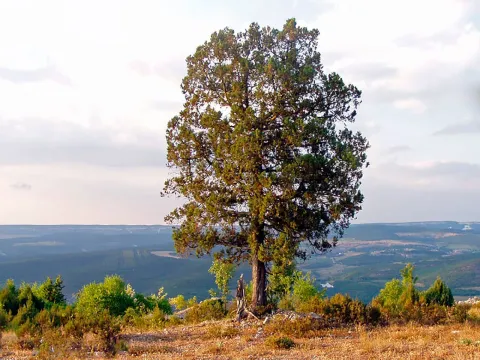
Greek juniper
Juniperus excelsa
The Greek juniper (Juniperus excelsa) is a long-lived, evergreen conifer belonging to the Cupressaceae family. Known for its pyramidal habit, this species can reach heights of up to 15 meters, making it a prominent element in its natural habitats.
What the section contains
Greek juniper
This species is highly xerophytic and requires full sun to maintain its density and characteristic blue-green foliage. It is naturally adapted to harsh, mountainous environments, often found growing on rocky outcrops where other vegetation struggles to survive.
Soil requirements are specific: the plant demands excellent drainage. It thrives in calcareous and alkaline soils but will suffer from root rot if subjected to waterlogged conditions. It is a slow-growing tree that requires patience in agricultural and landscape settings.
The native range of the Greek juniper includes the eastern Mediterranean and Central Asia. It is highly tolerant of drought and extreme temperature fluctuations, provided the root zone is protected from excessive moisture accumulation during the winter months.
Regarding its utility, the species is primarily used for soil stabilization in erosion-prone areas and as an ornamental specimen in xeriscaping projects. Its wood is naturally rot-resistant, although its conservation status often limits widespread harvesting.
Rust diseases are the most common pathological threat to Juniperus excelsa. These fungal infections often manifest as galls on the branches, which can lead to localized dieback if not managed through proper sanitary pruning and chemical intervention.
Insect pests, specifically scale insects and spider mites, are frequent issues in cultivation. These pests suck the sap from the needles, leading to yellowing, loss of vigor, and stunted growth if the infestation remains uncontrolled.
Agricultural management requires integrated pest management (IPM) strategies, including the use of systemic insecticides during early spring to break the life cycle of common pests. Maintaining proper distance between plants helps improve airflow and reduces moisture-related fungal growth.
For preventive care, monitoring for signs of stress or pest activity should be conducted regularly. Ensuring that the crown is not excessively pruned is essential, as the species does not regenerate well from old wood.
- Sanitary pruning of dead branches
- Monitoring for scale insects
- Applying fungicides for rust
- Ensuring excellent soil drainage