
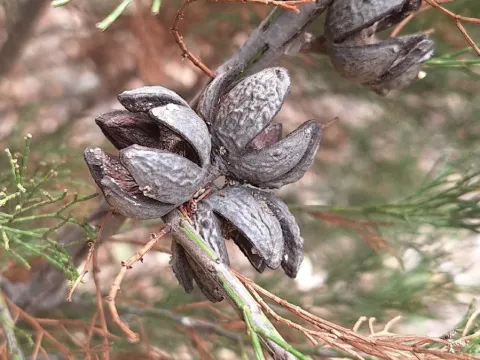
Callitris
Callitris
Callitris is a genus of coniferous trees and shrubs belonging to the Cupressaceae family. Known commonly as cypress pine, these plants are renowned for their adaptation to harsh environments and their highly durable, rot-resistant wood.
What the section contains
 Bailey cypress
Callitris baileyi
Bailey cypress
Callitris baileyi
 Callitris endlicheri
Callitris endlicheri
Callitris endlicheri
 Callitris oblonga
Callitris oblonga
Callitris oblonga
 Callitris sulcata
Callitris sulcata
Callitris sulcata
 Drummond's cypress pine
Callitris drummondii
Drummond's cypress pine
Callitris drummondii
 Grey cypress pine
Callitris canescens
Grey cypress pine
Callitris canescens
 Mountain cypress pine
Callitris monticola
Mountain cypress pine
Callitris monticola
 Mueller's cypress pine
Callitris muelleri
New Caledonian Cypress
Callitris neocaledonica
Mueller's cypress pine
Callitris muelleri
New Caledonian Cypress
Callitris neocaledonica
 Oyster bay pine
Callitris rhomboidea
Oyster bay pine
Callitris rhomboidea
 Port Macquarie pine
Callitris macleayana
Port Macquarie pine
Callitris macleayana
 Roe's Cypress Pine
Callitris roei
Roe's Cypress Pine
Callitris roei
 Scrub cypress
Callitris verrucosa
Scrub cypress
Callitris verrucosa
 White Cypress Pine
Callitris columellaris
White Cypress Pine
Callitris columellaris
Callitris
The native range of Callitris is primarily Australia, where it thrives in diverse ecosystems, from arid woodlands to rocky ranges. The genus is characterized by its scale-like leaves and distinctive cones that typically persist on the branches for extended periods.
Successful cultivation requires well-drained soil, as the plants are highly susceptible to root rot in waterlogged conditions. They prefer sandy or rocky soil types that mimic their natural habitat and require full exposure to sunlight for optimal growth.
Regarding climate, Callitris species are generally drought-tolerant and well-suited to subtropical and warm-temperate regions. They are sensitive to prolonged, severe frost, which limits their cultivation to milder climatic zones.
Economically, Callitris is prized for its high-quality timber, which is extensively used for decking, garden furniture, and termite-resistant construction. The aromatic wood remains a significant resource in the forestry industry of its native regions.
Root rot, specifically caused by fungal pathogens in damp conditions, is the primary threat to Callitris plantations. Ensuring proper site drainage during the establishment phase is essential for preventing these issues.
Wood-boring insects and bark beetles pose a risk to the health of mature trees. Regular monitoring and the prompt removal of weakened or infested specimens are standard agricultural practices to manage these pest populations.
Seedlings are vulnerable to browsing by herbivorous mammals, which necessitates the use of tree guards or fencing during the initial years of development to ensure plantation survival.
The resinous nature of the wood makes mature stands highly flammable, requiring strict fire management protocols. Creating firebreaks around plantation areas is a crucial preventative measure for long-term sustainability.
While Callitris is generally resilient, competitive weed pressure can significantly inhibit seedling growth. Effective site preparation and manual weeding are recommended during the early stages of the crop cycle.