
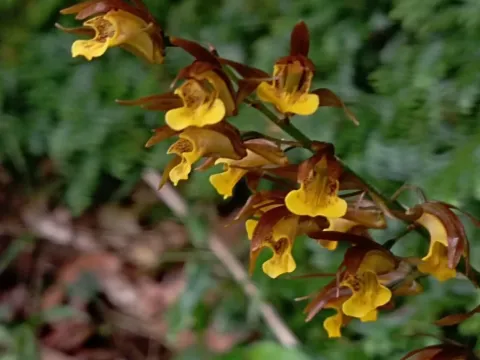
Tainia
Tainia
Tainia is a genus of perennial herbaceous plants belonging to the Orchidaceae family. These orchids are typically sympodial, growing from a creeping rhizome that produces pseudobulbs, which serve as water and nutrient storage organs.
What the section contains

Tainia
The native distribution of Tainia spans across tropical and subtropical regions of Asia, including Southeast Asia, China, and Japan. They are primarily found in shaded forest floors, thriving in environments characterized by high humidity and consistent moisture levels.
When cultivated, Tainia requires bright but indirect light conditions to mimic the forest canopy environment. Direct sunlight should be strictly avoided as it can cause significant physiological damage to the foliage and pseudobulbs.
The growing medium must be highly porous and well-draining, consisting of a mix of bark, perlite, and sphagnum moss. This composition ensures that roots receive adequate aeration while maintaining sufficient moisture to prevent desiccation.
Temperature requirements for most Tainia species fall within a moderate range, generally between 18°C and 25°C. Providing a stable environment without sudden temperature spikes or cold drafts is essential for healthy growth and successful flowering cycles.
The primary threats to Tainia orchids involve improper watering practices, which often lead to fungal infections and root rot. Waterlogged substrates effectively suffocate the roots, leading to rapid tissue decay and eventual plant collapse.
Pests such as mealybugs, aphids, and spider mites can infest these plants, especially in dry environments with poor air circulation. These insects sap the plant's vitality and can spread viral diseases, making regular inspection a crucial aspect of care.
Chemical control using systemic insecticides is effective against persistent infestations. However, it is imperative to use products specifically formulated for orchids to avoid phytotoxic reactions, as these plants can be sensitive to harsh chemicals.
Fungal leaf spots and bacterial blights are often exacerbated by high humidity coupled with stagnant air. Improving ventilation through the use of small fans can significantly reduce the risk of such outbreaks by keeping leaf surfaces dry.
If decay is detected, immediate action must be taken by pruning affected tissue with sterilized cutting tools. Treating the remaining healthy parts with a fungicide and repotting the plant into fresh substrate is the standard corrective measure.