
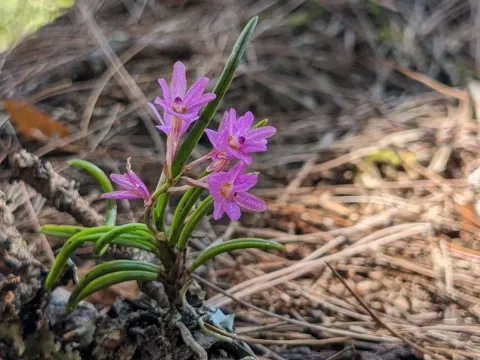
Holcoglossum
Holcoglossum
Holcoglossum is a genus of epiphytic orchids belonging to the Orchidaceae family. These plants are native to the high-altitude forests of East and Southeast Asia, typically growing on the branches of trees in humid, mist-covered environments.
What the section contains

Holcoglossum
Successful cultivation of Holcoglossum requires bright, indirect sunlight. In their natural habitat, they receive filtered light through the forest canopy, so mimicking this intensity is essential to prevent leaf scorch and ensure healthy vegetative development.
Temperature management is critical for this species. They generally thrive in intermediate to cool temperature ranges and require a distinct diurnal temperature drop at night, which is a key environmental trigger for inducing the flowering process.
The substrate must be highly porous and well-draining, as the roots require constant access to airflow. A mixture of coarse bark, charcoal, and perlite or sphagnum moss is commonly used in open-slatted baskets or pots to prevent moisture stagnation.
High humidity levels, ideally between 60% and 80%, are necessary to maintain the plant's health. In a home environment, humidity trays or mechanical humidifiers are often required to replicate the atmospheric moisture these plants encounter in nature.
The primary threats to Holcoglossum are fungal and bacterial rots, which often develop when the roots are kept too wet for too long or if there is poor air circulation around the root zone and leaf axils.
Pests such as scale insects and spider mites are frequent intruders. Spider mites, in particular, are attracted to these orchids when the surrounding air becomes too dry and stagnant, weakening the plant's natural defenses.
Regular inspection is the best defense against infestations. If pests are detected, targeted application of horticultural oils or mild systemic insecticides can be effective, though users must be careful with sensitive orchid tissues.
Sanitation is vital in preventing disease. Keeping the growing area clean and ensuring that water does not pool in the crown of the orchid helps to mitigate the risk of crown rot, which can be fatal to the plant.
Improper water quality can also cause issues. Using hard tap water can lead to mineral salt accumulation in the substrate, which harms the delicate root tips and stunts overall plant growth over time.