
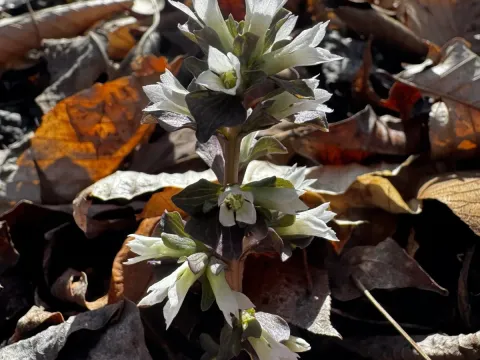
Obolaria
Obolaria
Obolaria virginica, commonly known as Virginia pennywort, is a member of the Gentianaceae family. It is distinct for its partial mycoheterotrophic nature, relying on symbiotic relationships with soil fungi to supplement its nutritional intake.
What the section contains

Obolaria
The plant is native to the eastern parts of North America, typically found in moist, shaded deciduous forests. It thrives in soils rich in organic matter and leaf litter, which support the specific mycorrhizal networks it requires.
Botanically, Obolaria is a small perennial herb with succulent, scale-like leaves and small flowers that are often hidden within the foliage. This subtle morphology is an evolutionary adaptation to the deep-shade environment of the forest floor.
The plant has strict environmental requirements, including stable moisture levels and specific fungal partners. These complexities make it impossible to cultivate in traditional agricultural settings or even standard greenhouse conditions.
Due to its high level of biological specialization, Obolaria is not used for agricultural or commercial production. It remains a subject of botanical interest, largely restricted to protected natural wilderness areas.
The primary threat to Obolaria populations is the destruction of its habitat. Deforestation and land development disrupt the delicate underground fungal networks necessary for the plant's survival.
Invasive species represent a significant threat to Obolaria, as they often outcompete native plants for space and resources. Changes in the local moisture balance can also cause rapid declines in population density.
There are no recorded agricultural pests or diseases for Obolaria, as it is not a cultivated crop. Threats are primarily ecological, stemming from the degradation of the forest ecosystems it occupies.
Environmental stress, such as soil compaction or pollution, can severely impact the plant's ability to undergo its annual life cycle. Its limited range makes it particularly susceptible to local extinction events.
Conservation of Obolaria relies entirely on habitat protection strategies. There are no agronomic management practices designed to protect this species from threats due to its strictly wild, non-agricultural nature.