
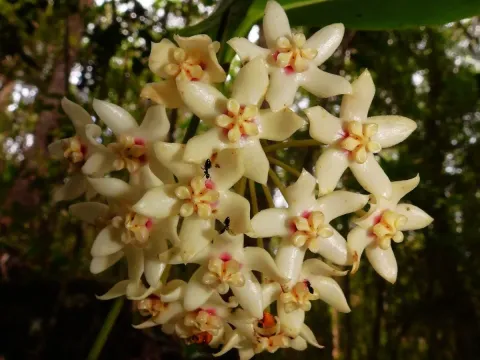
Hoya
Hoya R.Br.
Hoya (Hoya R.Br.) belongs to the Apocynaceae family and is a genus of evergreen tropical vines and shrubs. These plants originate from diverse regions, spanning from South Asia to Australia, where they thrive in humid and warm environments.
What the section contains


Hoya
Successful cultivation requires bright, indirect light. While they can tolerate some direct morning sun, intense afternoon rays often scorch their succulent-like leaves and prevent the plant from blooming efficiently.
The ideal temperature for Hoya is between 20°C and 25°C during the growing season. A distinct cooling period during the winter, where temperatures drop slightly to around 15°C, is often necessary to trigger the flower development process.
Soil requirements focus on high aeration and drainage. A standard potting mix is often unsuitable; instead, a mix containing orchid bark, perlite, and high-quality peat moss is recommended to mimic their epiphytic nature.
Watering should be practiced with caution. It is vital to let the potting medium dry out significantly between waterings to prevent root rot, as these plants are highly sensitive to soggy soil conditions.
Common pests that infest Hoya include mealybugs, scale insects, and spider mites. Mealybugs, in particular, often cluster in leaf axils and along the stems, causing stunted growth and leaf drop.
Fungal and bacterial diseases are typically caused by overwatering or high humidity combined with poor airflow. These issues manifest as dark spots on leaves or stem rot that can quickly spread to the entire root system.
Management of these threats involves isolating the affected plant and applying targeted treatments, such as horticultural oils or systemic insecticides, to ensure the eradication of pests.
To keep the plant healthy, regular cleaning of the leaves with a damp cloth prevents dust accumulation and reduces the likelihood of mite outbreaks, while also improving the aesthetic appearance.
If the plant shows yellowing leaves, it is often a sign of root distress. Promptly inspecting the roots for signs of decay and repotting into fresh, airy substrate can often save a struggling Hoya.