
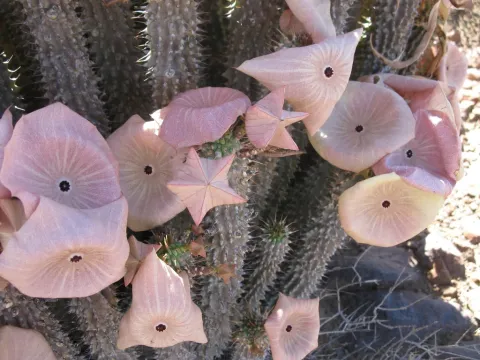
Hoodia
Hoodia
Hoodia is a genus of flowering plants within the Apocynaceae family. These succulents are characterized by their thick, succulent stems and spines, resembling cacti in appearance and adaptation strategies developed over centuries of evolution.
What the section contains

Hoodia
The plant originates from the arid regions of Southern Africa, including Namibia, Botswana, and South Africa. It thrives in the harsh environment of the Kalahari Desert, where it has adapted to intense solar radiation and scarcity of water.
To cultivate Hoodia successfully, one must replicate its natural desert conditions by providing high-intensity light exposure throughout the year. The plant requires a well-draining, sandy substrate that prevents any accumulation of moisture near the root zone.
Temperature management is crucial for the healthy development of Hoodia. The species performs best in a range of 20 to 30 degrees Celsius during the active growth phase, while requiring a cooler resting period during the winter months.
Irrigation must be handled with extreme care, following the principle of complete substrate dehydration between watering events. Excessive moisture, particularly in cool conditions, is the most common cause of plant failure in agricultural settings.
The primary threats to Hoodia cultivation are fungal and bacterial rots, which usually stem from overwatering or inadequate soil aeration. Once internal stem rot begins, it is often difficult to salvage the entire specimen.
Pest pressures primarily come from mealybugs and spider mites, which can drain the plant's resources. Regular monitoring of the stem surfaces and the base of the plant is recommended to catch infestations before they cause significant damage.
Integrated pest management strategies for Hoodia include maintaining clean cultivation environments and applying specific acaricides or systemic insecticides when necessary, always ensuring the soil is not overly saturated during treatment.
Structural integrity of the stems can be compromised by poor environmental conditions, leading to physical damage. Proper airflow is essential to prevent the accumulation of humidity, which serves as a catalyst for various opportunistic pathogens.
Beyond its ornamental and botanical interest, Hoodia holds economic importance for its bioactive compounds. These substances, particularly in species like Hoodia gordonii, are studied for their pharmacological potential in appetite regulation and dietary research.