
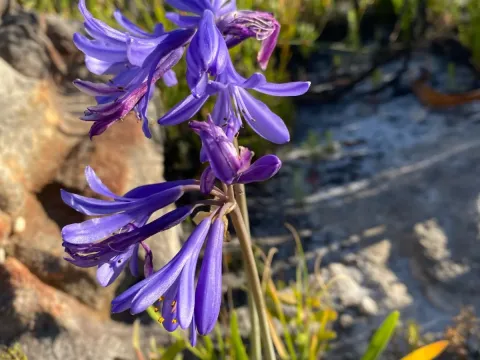
Agapanthus
Agapanthus L'Hér.
Propagation of Agapanthus is primarily achieved through vegetative division of the rhizomes, which should be performed in early spring or immediately after the flowering season ends.
What the section contains
 African lily
Agapanthus africanus (L.) Hoffmanns.
African lily
Agapanthus africanus (L.) Hoffmanns.
 African Lily
Agapanthus inapertus Beauverd subsp. Inapertus
African Lily
Agapanthus inapertus Beauverd subsp. Inapertus
 African lily
Agapanthus praecox Willd.
Agapanthus
Agapanthus africanus x Agapanthus inapertus
African lily
Agapanthus praecox Willd.
Agapanthus
Agapanthus africanus x Agapanthus inapertus
 Agapanthus campanulatus
 F. M. Leight.
Agapanthus campanulatus subsp. patens
Agapanthus campanulatus F. M. Leight. subsp. patens (F. M. Leight.) F. M. Leight.
Agapanthus campanulatus
Agapanthus campanulatus F. M. Leight.
Agapanthus campanulatus subsp. patens
Agapanthus campanulatus F. M. Leight. subsp. patens (F. M. Leight.) F. M. Leight.
 Agapanthus caulescens
 Sprenger
Agapanthus comptonii
Agapanthus comptonii F. M. Leight.
Agapanthus caulescens
Agapanthus caulescens Sprenger
Agapanthus comptonii
Agapanthus comptonii F. M. Leight.
 Agapanthus inapertus hollandii
Agapanthus inapertus Beauverd subsp. hollandii (F. M. Leight.) F. M. Leight.
Agapanthus inapertus subsp. intermedius
Agapanthus inapertus Beauverd subsp. intermedius F. M. Leight.
Agapanthus inapertus subsp. parviflorus
Agapanthus inapertus Beauverd subsp. parviflorus F. M. Leight.
Agapanthus praecox subsp. orientalis
Agapanthus praecox subsp orientalis (F.M. Leight) F.M. Leight.
Drooping agapanthus
Agapanthus inapertus Beauverd
Agapanthus inapertus hollandii
Agapanthus inapertus Beauverd subsp. hollandii (F. M. Leight.) F. M. Leight.
Agapanthus inapertus subsp. intermedius
Agapanthus inapertus Beauverd subsp. intermedius F. M. Leight.
Agapanthus inapertus subsp. parviflorus
Agapanthus inapertus Beauverd subsp. parviflorus F. M. Leight.
Agapanthus praecox subsp. orientalis
Agapanthus praecox subsp orientalis (F.M. Leight) F.M. Leight.
Drooping agapanthus
Agapanthus inapertus Beauverd
 Hybrid Agapanthus
Agapanthus campanulatus x Agapanthus praecox
Hybrid Agapanthus
Agapanthus inapertus x Agapanthus praecox subsp orientalis
Hybrid Agapanthus
Agapanthus campanulatus x Agapanthus praecox
Hybrid Agapanthus
Agapanthus inapertus x Agapanthus praecox subsp orientalis
 Hybrids of Agapanthus campanulatus and Agapanthus comptonii
hybrids between Agapanthus campanulatus F. M. Leight. and Agapanthus comptonii F. M. Leight.
Hybrids of Agapanthus campanulatus and Agapanthus comptonii
hybrids between Agapanthus campanulatus F. M. Leight. and Agapanthus comptonii F. M. Leight.
Agapanthus
If using seeds, sow them in the spring using a light, nutrient-rich substrate, maintaining temperatures between 20–22 degrees Celsius to ensure successful germination.
Seedlings develop relatively slowly, and it may take three to five years before a plant grown from seed reaches its full flowering potential.
It is critical to use fresh seeds for sowing, as their viability decreases significantly if stored for extended periods under improper conditions.
Commercial nurseries prefer division, as this method ensures the maintenance of specific cultivar traits and produces mature, flowering-ready plants much faster.
Agapanthus belongs to the Agapanthaceae family (formerly often classified under Amaryllidaceae). This perennial herbaceous plant is native to South Africa and thrives in open, sunny locations.
The crop requires fertile, loose, and well-drained soil with a neutral or slightly acidic pH, as waterlogged conditions are highly detrimental to root health.
During the growing season, the plant needs regular yet moderate watering; however, water requirements should be kept to a minimum during the winter dormancy period.
Temperature is a crucial factor; most species are heat-loving and require protection or relocation to a sheltered environment if temperatures drop below freezing.
The plant responds well to balanced mineral fertilizers applied during the active growth phase to support the production of its characteristic umbel-shaped flower clusters.
The most common issue resulting from poor horticultural practices is root rot, which typically develops due to overwatering or poorly aerated, heavy soil.
Pests such as spider mites and mealybugs frequently infest the foliage, particularly in environments characterized by dry air and high temperatures.
Slugs and snails can cause significant damage to young shoots and leaves, especially in humid regions during the spring and summer growth cycles.
To prevent the spread of diseases, it is essential to maintain proper spacing between plants and carry out regular sanitation by removing dead or decaying tissue.
When pests are detected, appropriate insecticides or acaricides should be used according to the manufacturer’s instructions to ensure effective control.
In ornamental gardening, the term "harvesting" refers to the removal of spent flower stalks after the bloom has finished to prevent plant exhaustion and maintain appearance.
Stalks should be cut using clean, sharp tools to minimize the risk of introducing pathogens into the rhizome system through open wounds.
In colder climates, Agapanthus is often treated as a container plant and must be lifted in autumn to be moved into storage facilities for the winter.
When lifting rhizomes, it is vital to preserve the integrity of the root system and carefully remove excess soil before placing them into winter storage.
Storage should take place in a dry area with moderate temperatures to ensure the plant remains viable until the next growing season begins.