
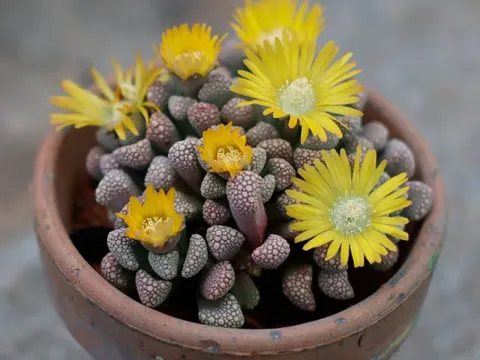
Titanopsis
Titanopsis
Propagation of Titanopsis by seed is best performed in spring when daylight hours increase. Sowing in March or April provides seedlings with the best environment for initial growth.
What the section contains

Titanopsis
Seeds are sown on the surface of a substrate consisting of sand and loam. Covering them with a thin layer of sand is sufficient, as they require light and air circulation to germinate effectively.
Maintaining a greenhouse effect is crucial: the container should be covered with glass or film to keep humidity stable. The temperature should be maintained between 20 and 25 degrees Celsius.
Once seedlings emerge, the cover should be removed gradually to acclimatize the young plants. Pricking out is only performed after the development of the second pair of true leaves.
In commercial settings, artificial lighting allows for year-round sowing, though the natural spring cycle remains the most reliable method for strengthening the plant's natural immune system.
Titanopsis belongs to the Aizoaceae family and originates from the arid regions of South Africa. The plant is adapted to extreme temperatures and very scarce precipitation.
The species requires intense light for healthy growth. If kept in dim light, the plant loses its characteristic rosette shape and becomes elongated, making it prone to structural weakness.
The soil must have excellent drainage characteristics. A mix of coarse sand, gravel, and a small amount of turf soil with some lime added is considered the ideal substrate for this plant.
Watering should be very restricted: during the active growth period, it should only be done after the substrate has completely dried out. In winter, during dormancy, watering should be almost completely withheld.
Stagnant water at the roots is fatal for this plant, as it leads to rapid tissue rot. Therefore, using pots with large drainage holes and a substantial bottom layer of expanded clay is a mandatory agricultural practice.
Fungal diseases are the primary threat to Titanopsis, usually caused by excessive soil moisture. Root rot and stem rot are the most common causes of mortality in this succulent.
Pests, such as mealybugs and spider mites, can also cause significant damage. These insects suck the sap from the succulent leaves, weakening the plant and causing aesthetic damage.
Prevention of fungal issues involves strict adherence to watering schedules and ensuring good air circulation around the plants. Fungicides should only be applied if initial symptoms of decay appear.
Pest control is achieved through the use of systemic insecticides or miticides. Isolating infected specimens is a necessary measure to prevent the spread of pests throughout the collection.
Additionally, growers must be cautious of sudden exposure to intense sun after a period of dormancy, as it can cause sunburn, which serves as a gateway for pathogens to enter the leaf tissues.