
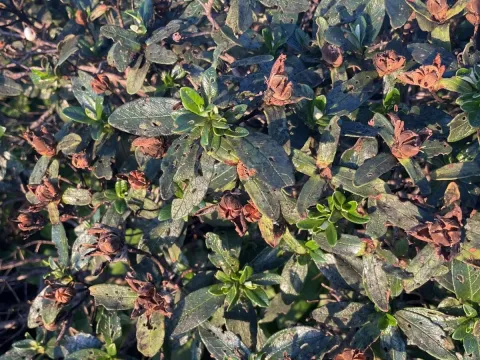
Cistus
Cistus L.
Cistus is typically propagated from seeds sown in the early spring, ensuring the soil temperature reaches at least 15 to 20 degrees Celsius.
What the section contains
 Cistus dansereaui
Cistus x dansereaui P. Silva
Cistus lenis
Cistus x lenis Demoly
Cistus dansereaui
Cistus x dansereaui P. Silva
Cistus lenis
Cistus x lenis Demoly
 Cistus x argenteus
 Dansereau
Cistus x argenteus
Cistus x argenteus Dansereau
 Cistus x pulverulentus
 Pourr.
Cistus x pulverulentus
Cistus x pulverulentus Pourr.
 Florentine Rockrose
Cistus florentinus Lam.
Grey-leaved cistus
Cistus x incanus L.
Hybrid rockrose
Cistus x hybridus Pourr.
Labdanum rockrose
Cistus ladanifer L.
Loose rockrose
Cistus x laxus Aiton
Florentine Rockrose
Cistus florentinus Lam.
Grey-leaved cistus
Cistus x incanus L.
Hybrid rockrose
Cistus x hybridus Pourr.
Labdanum rockrose
Cistus ladanifer L.
Loose rockrose
Cistus x laxus Aiton
 Montpelier rockrose
Cistus monspeliensis L.
Montpelier rockrose
Cistus monspeliensis L.
 Poplar-leaved Cistus
Cistus populifolius L.
Purple Rock Rose
Cistus x purpureus Lam.
Poplar-leaved Cistus
Cistus populifolius L.
Purple Rock Rose
Cistus x purpureus Lam.
 Rockrose
Cistus creticus L.
Rockrose
Cistus creticus L.
 Sage-leaved rock-rose
Cistus salviifolius L.
Sage-leaved rock-rose
Cistus salviifolius L.
 Sintenis Rockrose
Cistus sintenisii Litard.
Sintenis Rockrose
Cistus sintenisii Litard.
 Small-flowered rockrose
Cistus parviflorus Lam.
Small-flowered rockrose
Cistus parviflorus Lam.
Cistus
Seeds often require cold stratification to break dormancy and improve the overall germination rate in a professional nursery setting.
Transplanting seedlings to the field is recommended once the risk of spring frost has passed and the root system is sufficiently developed.
Proper spacing between plants, usually 80 centimeters apart, is critical to ensure adequate sunlight exposure and healthy foliage development.
Vegetative propagation via softwood cuttings taken in late spring is a viable alternative for maintaining specific cultivar traits and uniformity.
Cistus belongs to the Cistaceae family and is native to Mediterranean ecosystems, favoring well-drained, nutrient-poor, and rocky soil types.
Full sun is an absolute requirement for successful growth, as the plant needs intense light to synthesize its unique aromatic resins.
Soil pH should ideally be neutral or slightly acidic; the plant exhibits clear sensitivity to calcareous soils and waterlogged conditions.
It is remarkably drought-tolerant, having evolved to thrive in arid conditions with minimal precipitation through the course of the growing season.
Air circulation is vital to prevent fungal issues, so planting in elevated or wind-exposed areas is often preferred in agricultural production.
The yield of Cistus is measured by the biomass of leaves and young stems harvested for the extraction of labdanum, a valuable natural resin.
High-quality production is achieved through meticulous management, starting from the second or third year after the initial field establishment.
Productivity tends to peak as the shrubs mature, provided that periodic pruning is performed to manage the plant structure and encourage growth.
Harvesting efficiency is improved by selecting cultivars known for higher resin gland density, which directly correlates to the final oil output.
The industrial extraction process usually involves steam distillation or solvent extraction to capture the complex, woody scent profiles required for perfumery.
While naturally robust, Cistus is susceptible to root rot and other fungal diseases primarily caused by poor drainage or excessive soil moisture.
Pest pressure is relatively low due to the sticky resin coating the leaves, which acts as a natural defense mechanism against many insects.
Aphids can occasionally be observed in early spring, but they rarely reach levels requiring chemical intervention in healthy, well-maintained crops.
Good agricultural practices, such as weed control and optimal plant spacing, remain the best defense against potential biological threats to the crop.
Environmental stressors, such as severe winter freezing in non-adapted regions, can cause dieback and significantly reduce total plantation yield.
Harvesting is performed during the peak flowering stage to maximize the concentration of essential oils stored in the resinous foliage.
Techniques range from manual harvesting with pruning shears to mechanical harvesting, depending on the scale and topography of the site.
Post-harvest management is crucial; biomass should be processed or dried promptly to prevent the degradation of volatile aromatic compounds.
Drying is conducted in controlled, shaded conditions with continuous airflow to preserve the integrity of the labdanum resin during storage.
Properly cured and stored raw material is essential for maintaining the standard of quality demanded by international fragrance and medicinal markets.