
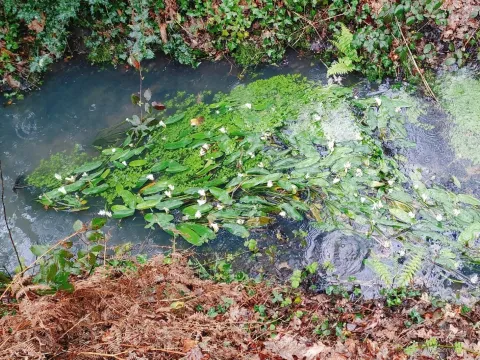
Aponogeton
Aponogeton
Aponogeton is a genus of perennial aquatic plants belonging to the monotypic family Aponogetonaceae. In their natural habitat, these plants are predominantly found in the tropical and subtropical regions of Africa, Asia, and Australia.
What the section contains
 Aponogeton abyssinicus
Aponogeton abyssinicus
Aponogeton abyssinicus
 Aponogeton boivinianus
Aponogeton boivinianus
Aponogeton boivinianus
 Aponogeton crispus
Aponogeton crispus
Aponogeton crispus
 Aponogeton desertorum
Aponogeton desertorum
Aponogeton desertorum
 Aponogeton hybrids
Aponogeton hybrids
Aponogeton hybrids
 Aponogeton junceus
Aponogeton junceus
Aponogeton junceus
 Aponogeton lakhonensis
Aponogeton lakhonensis
Aponogeton lakhonensis
 Aponogeton longiplumulosus
Aponogeton longiplumulosus
Aponogeton longiplumulosus
 Aponogeton madagascariensis
Aponogeton madagascariensis
Aponogeton madagascariensis
 Aponogeton rigidifolius
Aponogeton rigidifolius
Aponogeton rigidifolius
 Aponogeton robinsonii
Aponogeton robinsonii
Aponogeton robinsonii
 Aponogeton subconjugatus
Aponogeton troupinii
Aponogeton troupinii
Aponogeton subconjugatus
Aponogeton subconjugatus
Aponogeton troupinii
Aponogeton troupinii
 Aponogeton ulvaceus
Aponogeton vallisnerioides
Aponogeton vallisnerioides
Aponogeton ulvaceus
Aponogeton ulvaceus
Aponogeton vallisnerioides
Aponogeton vallisnerioides
 Wavy-leaf Aponogeton
Aponogeton undulatus
Wavy-leaf Aponogeton
Aponogeton undulatus
Aponogeton
The culture is a typical hydrophyte that requires constant submersion in an aquatic environment. Optimal growth conditions involve intense lighting, although some species are sensitive to direct sunlight and prefer light shading.
Plants are highly demanding regarding water quality, favoring soft or moderately hard water with a neutral or slightly acidic pH level. Regular water circulation is essential to ensure the constant supply of nutrients to the root system.
The substrate for Aponogeton should be nutritious, silt-rich, and contain sufficient organic matter. In commercial aquaculture, a mixture of sand, clay, and peat is recommended to support robust root development.
The temperature regime varies by species, but for most varieties, an optimal range is between 22 and 26 degrees Celsius. It is critical to avoid sharp temperature fluctuations, which can trigger an unwanted dormant phase.
The commercial use of Aponogeton is focused on the ornamental fish industry and aquarium trade, as well as the consumption of tubers of certain species. In parts of Southeast Asia, the tubers of species like Aponogeton crispus are cooked and eaten as food.
Biomass production relies on active photosynthesis under water. In professional nurseries, yield efficiency depends heavily on planting density and the concentration of dissolved carbon dioxide.
Propagation is carried out through both vegetative methods (dividing rhizomes) and seed production. The productivity of healthy mother plants allows for a sustainable supply of offspring throughout the growing season.
Marketable quality is determined by the development of leaf blades and the strength of the root system. High-quality planting stock must possess a clear, active growth point with no signs of nutrient deficiency.
The industrial efficiency of growing Aponogeton is increasingly linked to advanced hydroponic techniques and closed-circuit water management systems.
The primary diseases of this crop are associated with imbalances in water chemistry. A deficiency in iron and other macro-elements frequently causes chlorosis, leading to yellowing and decay of the leaves.
Excessive lighting or an imbalance in the biological environment can lead to the growth of filamentous algae, which compete with and suppress the development of the Aponogeton.
Pests can cause damage if plants are maintained in systems with herbivorous fish or mollusks. Damage to the root system often triggers bacterial rot, which can be fatal to the plant.
To prevent these issues, it is essential to maintain water purity and perform regular fertilization using specialized complex fertilizers designed for aquatic flora.
Infectious fungal diseases are relatively rare but require the immediate removal of affected plant parts to prevent the spread of pathogens throughout the cultivation system.