
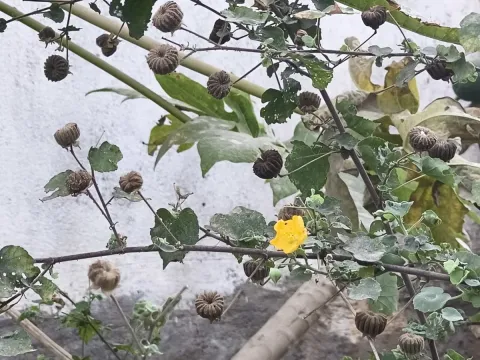
Abutilon
Abutilon Mill.
Abutilon seeds are typically sown when soil temperatures reach 12–15°C, ensuring that the ground has sufficiently warmed after the last spring frosts.
What the section contains
 Abutilon megapotamicum
 (Spreng.) A. St.-Hil. & Naudin
Abutilon megapotamicum
Abutilon megapotamicum (Spreng.) A. St.-Hil. & Naudin
 Abutilon mollis
 Sweet
Abutilon mollis
Abutilon mollis Sweet
 Abutilon ochsenii
 (Phil.) Reiche
Abutilon ochsenii
Abutilon ochsenii (Phil.) Reiche
 Abutilon pictum
 (Gillies ex Hook. & Arn.) Walp.
Abutilon pictum
Abutilon pictum (Gillies ex Hook. & Arn.) Walp.
 Abutilon vitifolium
 (Cav.) C. Presl
Abutilon vitifolium
Abutilon vitifolium (Cav.) C. Presl
 Abutilon x hybridum
 hort. ex Voss
Abutilon x hybridum
Abutilon x hybridum hort. ex Voss
 Darwin's abutilon
Abutilon darwinii Hook. f.
Darwin's abutilon
Abutilon darwinii Hook. f.
 Miller's Abutilon
Abutilon x milleri hort.
Miller's Abutilon
Abutilon x milleri hort.
 Suntense abutilon
Abutilon x suntense C. D. Brickell
Suntense abutilon
Abutilon x suntense C. D. Brickell
 Velvetleaf
Abutilon theophrasti Medik.
Velvetleaf
Abutilon theophrasti Medik.
Abutilon
The sowing method usually involves row planting with spacing between 30 and 45 centimeters to provide adequate room for optimal biomass development.
Seed depth is generally maintained at 2–3 centimeters, allowing for efficient germination while preventing the drying out of the seeds in the upper soil layer.
Proper plant density is critical for fiber quality, as it encourages the development of tall, straight stems with minimal branching during the growth phase.
Uniform planting is recommended to facilitate future mechanical operations, including weeding and fertilization, which are essential for crop establishment.
As a member of the Malvaceae family, Abutilon is a heat-loving crop that thrives in regions with plenty of sunlight and temperatures between 20–28°C.
The crop prefers fertile, well-drained loamy soils that allow for good aeration and provide the necessary nutrients for rapid growth during the summer season.
Although it is known for its relative drought tolerance compared to other fiber crops, consistent moisture during the early vegetative stage is beneficial.
Avoiding waterlogged conditions is essential, as saturated soils can inhibit root development and significantly increase the susceptibility of the plant to rot.
Strategic fertilization with nitrogen and phosphorus helps promote vigorous stem growth, which is the primary objective for industrial fiber production.
The economic output of Abutilon centers on its high-quality bast fiber, which is frequently compared to jute due to its strength and industrial versatility.
Average yields of dry stems range from 1.5 to 2.5 tons per hectare, depending on soil management practices, variety selection, and environmental conditions.
In addition to the fiber, the seeds of the Abutilon plant contain valuable technical oils that can be extracted for various industrial applications.
The total fiber yield is maximized by strictly adhering to the harvest timeline, as delayed collection leads to thicker, less flexible fiber strands.
Efficient processing facilities are required to separate the bast fiber from the core (hurd) material to ensure the highest market value for the final product.
Abutilon can be susceptible to various fungal diseases, such as Fusarium wilt and powdery mildew, particularly in dense, poorly ventilated stands.
Insect pests, including aphids and leaf-eating beetles, can cause significant damage to the foliage, thereby reducing the plant's overall photosynthetic capacity.
Integrated pest management, including crop rotation and the use of resistant varieties, is highly recommended to mitigate these potential threats.
- Fusarium wilt
- Powdery mildew
- Aphids
- Root-knot nematodes
Monitoring the fields during the early growth stages is crucial for the early detection and management of pest and disease outbreaks.
Harvesting for fiber is typically performed at the start of the flowering stage, which represents the optimal balance between stem height and fiber quality.
The crop is cut close to the ground, and the stems are often left in the field for initial drying or bundled for immediate processing in dedicated facilities.
Mechanical harvesting equipment must be properly adjusted to ensure a clean cut and minimal loss of fiber during the collection and baling processes.
The traditional retting process is utilized to break down the plant tissues and separate the long fibers from the woody core of the stems.
Once retted, cleaned, and dried, the fiber is sorted by length and strength, preparing it for industrial use in textiles, paper manufacturing, or cordage.