
Erechtites
Erechtites
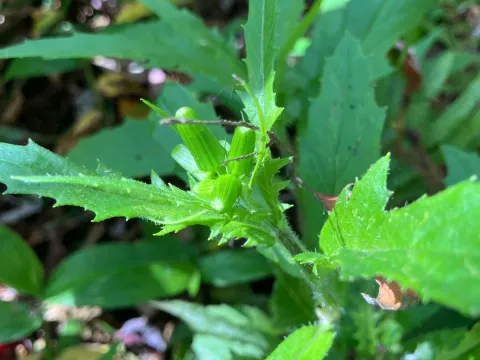
Erechtites is a genus of flowering plants in the sunflower family (Asteraceae). These plants are annual herbs, often reaching significant heights and possessing a robust, upright growth habit.
What the section contains
Erechtites
The leaves are typically alternate, with serrated or lobed margins. The plant produces small, cylindrical flower heads that are often arranged in loose, terminal panicles.
One of the most notable features of Erechtites is its seed dispersal mechanism. The seeds, known as achenes, have a tuft of bristles (pappus) that allows them to be transported by the wind over long distances.
Physiologically, the plant is adapted to thrive in disturbed soil, which allows it to quickly colonize agricultural land after tillage or harvesting operations.
Distinguishing Erechtites from similar-looking Asteraceae requires close inspection of the floral structures, specifically the arrangement of the phyllaries surrounding the flower head.
Erechtites species are commonly found in open, disturbed habitats including field edges, forest clearings, and recently cultivated agricultural land with sufficient moisture.
In cropping systems, this weed often becomes problematic in row crops and vegetable fields where soil disturbance provides an ideal environment for germination.
The plant demonstrates high ecological plasticity, allowing it to grow in various soil types as long as there is enough sunlight and moisture to support its rapid biomass accumulation.
It frequently emerges in waves throughout the growing season, particularly following rainfall events, which necessitates repeated monitoring of the fields.
The weed is often introduced to new fields through contaminated machinery or by wind-dispersed seeds from adjacent non-agricultural areas.
The primary damage caused by Erechtites is intense competition for essential resources such as nutrients, water, and sunlight, which can significantly stunt crop development.
By overtopping crops, the weed creates shade, reducing the photosynthetic efficiency of the primary agricultural plants and negatively affecting yield potential.
Erechtites also serves as a host for various insects and pathogens, increasing the risk of pest outbreaks and disease spread within the field.
The weed's presence complicates harvest logistics, as the dense green biomass can interfere with combine operations and increase the moisture content of the harvested crop.
Due to its high reproductive potential, a small infestation can quickly escalate into a widespread problem that requires intensive and costly management efforts over multiple years.
Mechanical control is effective in the early stages of growth. Shallow cultivation and inter-row hoeing can successfully eliminate seedlings before they establish a deep root system.
Cultural practices, such as choosing competitive crop varieties and optimizing plant density, help shade out the weed and suppress its growth throughout the season.
Chemical control involving selective herbicides is a standard approach. Treatment should be timed to the seedling or vegetative stage to maximize efficacy and minimize stress on the crop.
Sanitation of field borders and non-crop areas is essential to prevent the influx of wind-blown seeds into the main production zone.
- Implement timely mechanical weeding during the early vegetative phase.
- Use pre-emergent or post-emergent herbicides based on local resistance profiles.
- Maintain field hygiene by controlling weeds along fence lines and adjacent waste ground.