
Elegant tarweed
Madia elegans
Description
How to tell it apart
The elegant tarweed (Madia elegans) is a member of the Asteraceae family. It is an annual herbaceous plant that can reach heights ranging from 30 to 100 cm during its flowering stage.
The plant is densely covered with glandular hairs that secrete a sticky substance with a distinct, pungent smell, which complicates manual weeding efforts.
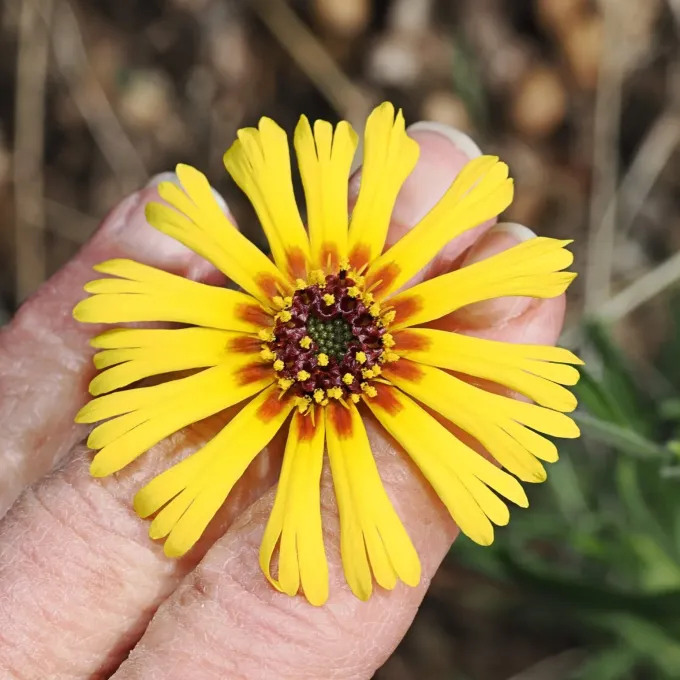
Its leaves are lanceolate or linear in shape and are arranged alternately along the stem. The inflorescences are flower heads with yellow or sometimes reddish-brown ray florets.
Flowering occurs from June through September. The seeds (achenes) are capable of remaining viable in the soil for several years, making long-term management necessary.
The plant actively attracts pollinators, and combined with high seed production, it can spread rapidly across adjacent fields and disturbed areas.
Where it grows
This species is native to western North America, where it is frequently found on open, dry sites, roadsides, and disturbed land.
In an agricultural setting, the elegant tarweed can infest grain and row crop fields, especially in regions with a temperate climate.
It is most commonly identified in fallow fields and on neglected land, from which it can migrate into active crop production areas.
The plant prefers well-lit areas and drained soils, often colonizing field edges where competition from cultivated crops is lower.
The ability of the elegant tarweed to tolerate short periods of drought makes it a significant competitor in semi-arid farming regions.
Harm it causes
The primary damage caused by tarweed is intense competition for moisture and nutrients during the early vegetative stages of cultivated crops.
Due to its rapid growth and extensive biomass, the weed shades out crop seedlings, slowing down their photosynthesis and overall development.
The presence of sticky resinous secretions hinders the harvesting process by fouling agricultural machinery parts and reducing the quality of harvested grain.
The elegant tarweed can serve as an alternate host for several pests and pathogens that affect plants within the Asteraceae family.
Heavy infestation of fields with elegant tarweed leads to significant yield losses, which can reach 15-20% under high density conditions.
How to control
Controlling the elegant tarweed requires a comprehensive strategy combining mechanical and chemical control measures.
The most critical agronomic technique is high-quality primary soil tillage, including deep plowing, which prevents seeds from germinating in deeper soil layers.
Timely inter-row cultivation in row crops is an effective method to destroy young weed seedlings before they reach the flowering stage.
The application of systemic herbicides during the early stages of weed development is essential to significantly reduce its population in cereal crops.
- Strict adherence to crop rotation cycles.
- Use of high-quality, weed-free planting seeds.
- Destruction of weeds on non-crop areas such as field margins and roadsides.
- Application of post-emergence herbicides according to local regulatory guidelines.
Taxonomy
- Latin name
- Madia elegans
- Family
- Сложноцветные (астровые)
- EPPO code
- MADEL