
Drummond's isocoma
Isocoma drummondii
Description
How to tell it apart
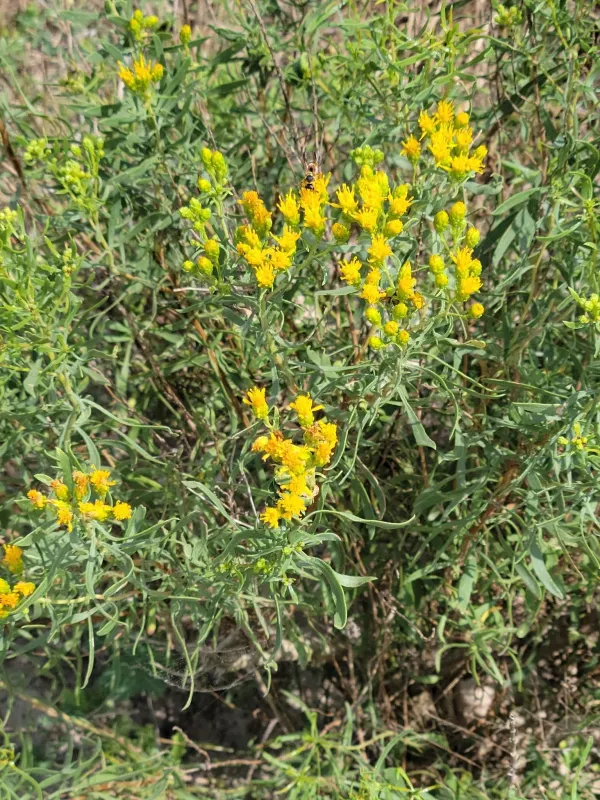
Drummond's isocoma (Isocoma drummondii) belongs to the Asteraceae family. It is a hardy, perennial subshrub characterized by stiff, upright stems that can reach substantial heights.
The leaves of this plant are typically linear or lanceolate, arranged in an alternate pattern, and are well-adapted to survive in arid, high-light intensity environments.
The plant produces dense, yellow flower heads composed of tubular florets, which bloom in late summer, leading to significant seed production and wind-driven dispersal.
Its root system is notably robust, often reaching deep into the soil profile, which allows it to secure water resources in competitive landscapes.
The biological nature of this plant makes it highly persistent, as it possesses the ability to withstand seasonal droughts that would suppress many other competing species.
Where it grows
Drummond's isocoma is native to the arid and semi-arid regions of North America, particularly throughout parts of the southern United States and northern Mexico.
This weed thrives in disturbed habitats, including overgrazed rangelands, degraded agricultural lands, and vacant lots where competition is minimal.
It often invades grasslands and pasturelands, significantly altering the composition of the vegetation and reducing the availability of desired forage.
It frequently colonizes roadsides, irrigation ditches, and waste areas, using these sites as reservoirs to spread seeds into neighboring cropland.
The plant demonstrates remarkable tolerance to saline soil conditions, enabling it to dominate areas where other vegetation struggles to establish itself.
Harm it causes
The primary concern regarding Drummond's isocoma is its toxicity to livestock, specifically cattle and sheep, as ingestion can lead to severe health issues for the animals.
As a highly competitive weed, it depletes limited water and nutrient resources, causing a measurable decline in the yield of nearby agricultural crops.
The infestation of this plant on rangelands results in long-term economic losses by reducing the total biomass of productive forage species.
The rigid stem structure of the plant interferes with standard mechanical farming equipment, increasing wear and tear and hindering efficient cultivation practices.
Furthermore, the weed acts as a host for various pests and diseases, increasing the overall phytosanitary burden on the agricultural ecosystem.
How to control
Cultural control methods involve deep mechanical plowing, which is essential to weaken the rootstock of this perennial plant and prevent regrowth.
Timely mowing or burning, performed before the plant reaches the seed-setting stage, is a critical practice to prevent the accumulation of a seed bank in the soil.
Chemical control is most effective when systemic herbicides are applied, as they are capable of translocating into the deep root system to achieve total eradication.
Application during the active vegetative growth stage provides the best results, ensuring the herbicide is effectively absorbed and moved throughout the plant.
- Regular monitoring of fields to detect early infestations before they spread.
- Implementation of grazing management plans to prevent overgrazing.
- Localized chemical treatments in areas where the weed has established dense clusters.
Taxonomy
- Latin name
- Isocoma drummondii
- Family
- Сложноцветные (астровые)
- EPPO code
- HAPDR