
Dittrichia graveolens
Dittrichia graveolens
Description
How to tell it apart
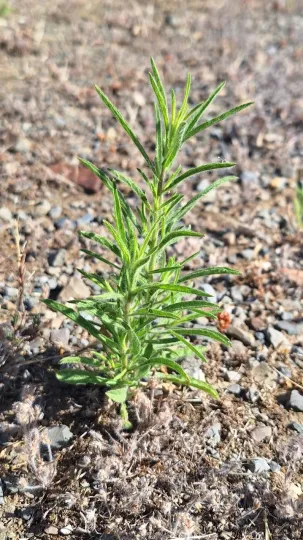
Dittrichia graveolens, commonly known as stinkwort, is an annual herbaceous plant in the Asteraceae family. It typically grows as a bushy, highly branched plant, reaching heights between 20 and 80 centimeters.
The leaves are linear to lanceolate, alternate, and covered with glandular hairs. These glands secrete sticky resins and essential oils, which give the plant its characteristic pungent, camphor-like smell, especially when the plant is crushed or handled.
The flowers are arranged in small yellow heads, grouped together in loose panicle-like clusters at the ends of branches. Each flower head is surrounded by bracts, and the plant produces a large number of seeds throughout the late summer and autumn months.
Each seed is equipped with a pappus, a tuft of fine hairs that allows for efficient wind dispersal. This mechanism enables the weed to spread rapidly across large distances, colonizing new landscapes, field edges, and disturbed soils.
As a prolific seed producer, a single healthy plant can disperse thousands of seeds, ensuring a robust soil seed bank that can persist through unfavorable conditions and germinate when moisture becomes available.
Where it grows
Dittrichia graveolens is highly adapted to disturbed environments and is frequently found along roadsides, railway tracks, industrial zones, and abandoned fields. It thrives in open, sunny locations with little competition from other vegetation.
It prefers well-drained, sometimes saline or rocky soils. Its deep-reaching root system allows it to withstand significant periods of drought, giving it a competitive edge in arid regions where other species might fail.
Within agricultural systems, it acts as a persistent weed in crop fields, particularly those with late-season growth cycles. It is also an opportunistic colonizer of pasturelands where the cover has been thinned by overgrazing or poor management.
The plant has expanded its range significantly due to human activity, with seeds often transported by machinery, vehicles, and contaminated grain or soil. Once established in a field, it is difficult to eradicate due to its aggressive growth habit.
It is capable of growing in various soil types, ranging from poor, gravelly soils to more fertile agricultural substrates, making it a highly adaptable and invasive weed in many Mediterranean and temperate climates.
Harm it causes
The primary agricultural impact of stinkwort is competition for essential resources. Its aggressive root system depletes soil moisture and nutrients, which can significantly reduce the yield of commercial crops growing nearby.
Stinkwort poses a health risk to livestock. The glandular hairs and essential oils contain compounds that can cause contact dermatitis in both humans and animals. If ingested by livestock, it can cause digestive irritation and potentially more severe toxicity symptoms.
Contamination of harvested grain with stinkwort seeds is a major economic issue. The presence of these seeds requires costly post-harvest cleaning and processing, which lowers the commercial value and marketability of the agricultural product.
In pastures and rangelands, it acts as an invasive species, crowding out desirable forage grasses and legumes. Its presence reduces the overall carrying capacity of the land and may lead to long-term degradation of natural grazing ecosystems.
Furthermore, it acts as a host for various insects and plant pathogens. By serving as an overwintering or off-season reservoir, it facilitates the spread of diseases to primary crops, complicating integrated pest management strategies.
How to control
Mechanical control is effective in the early stages of infestation. Deep plowing and thorough primary tillage can bury seeds, preventing germination. Regular cultivation between crop rows is essential for managing stinkwort in row crops like sunflowers or corn.
For non-crop areas, mowing before the plant reaches the flowering stage is a critical strategy to prevent seed set. While this does not kill the root system, it stops the rapid spread of seeds by wind and prevents the replenishing of the soil seed bank.
Chemical control involving systemic herbicides, such as those containing glyphosate, is often used on non-agricultural land or as a pre-plant treatment. In cereal crops, selective herbicides from the sulfonylurea group have shown efficacy when applied at the seedling stage.
The timing of herbicide application is paramount; younger, actively growing plants are far more susceptible to treatment than larger, mature plants that have developed a thick, resinous cuticle. Sequential treatments may be necessary to control successive germination flushes.
A comprehensive integrated management plan is the best defense. This includes rotation of crops, sound pasture management, and strict sanitation of farm machinery to prevent the movement of seeds between fields, ensuring that the weed does not gain a permanent foothold.
Taxonomy
- Latin name
- Dittrichia graveolens
- Family
- Сложноцветные (астровые)
- EPPO code
- INUGR