
Ericameria bloomeri
Ericameria bloomeri
Description
How to tell it apart
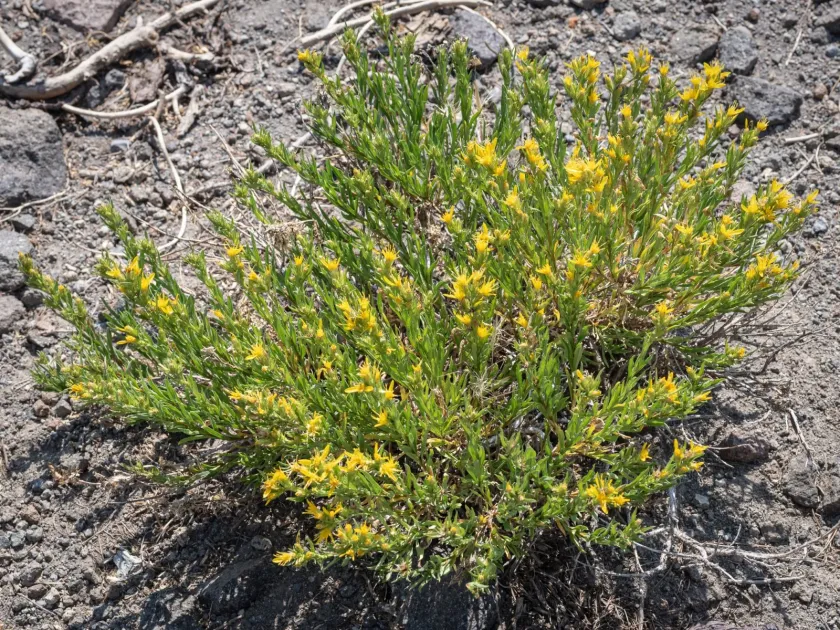
Ericameria bloomeri, commonly known as Bloomer's goldenbush, is a perennial subshrub belonging to the Asteraceae family. It is distinguished by its narrow, linear leaves that are frequently covered in a resinous, shiny coating.
The stems are rigid and semi-woody, growing between 20 and 60 centimeters in height. Its leaf arrangement is alternate, and the leaves themselves often contain glandular structures that give the plant a distinct aromatic profile.
The yellow flowers are arranged in small, dense heads lacking ray florets. These flower heads cluster at the tips of the stems, creating corymb-like inflorescences that become very visible during the blooming period.
A significant feature is the robust taproot system that penetrates deeply into the soil. This allows the plant to survive in harsh, rocky environments where competition for water is extremely high.
Seeds are equipped with a pappus, a tuft of bristles that acts as a sail, allowing the plant to spread its offspring over large distances through wind dispersal.
Where it grows
The species is native to western North America, typically occupying dry, rocky, and open habitats such as slopes and arid plains. It thrives in soils with low nutrient content and limited water availability.
In agricultural settings, Ericameria bloomeri often colonizes neglected pastures, rangelands, and fallow fields. It is highly opportunistic and quickly fills gaps created by overgrazing or land disturbance.
The weed is frequently found along field borders, drainage ditches, and roadsides, from where it slowly encroaches into actively cultivated land. It has a high tolerance for drought and can persist under conditions that are fatal to most crops.
The presence of this plant on land is often an indicator of long-term soil depletion or poor management practices. It is particularly persistent in areas where the soil has been heavily compacted or exposed to erosion.
Once established, the shrub creates stable patches that are difficult to eradicate without sustained effort. It does not require high levels of moisture, making it a constant threat in arid farming regions.
Harm it causes
The primary harm caused by Ericameria bloomeri is the degradation of grazing land. The plant is generally avoided by livestock due to the presence of unpalatable resins and essential oils, leading to a significant reduction in available forage.
In cropping systems, it acts as a strong competitor for soil moisture and nutrients. Because of its deep root system, it competes effectively with crops even in dry conditions, leading to reduced yield in adjacent fields.
The plant causes significant mechanical damage to agricultural machinery. Its woody and rigid stems can damage cutting equipment during harvest, resulting in increased maintenance costs and operational downtime.
When included in hay, the dried material reduces the quality of the fodder, as livestock often sort through and reject the woody parts. This wastes resources and necessitates additional cleaning of feed batches.
Its invasive nature means it can quickly take over large areas if left unchecked, turning productive fields into unproductive land that requires significant capital to restore to agricultural use.
How to control
Controlling Ericameria bloomeri requires a multi-faceted approach. Mechanical removal is effective only if the entire taproot is extracted, as the plant can readily resprout from remaining root fragments in the soil.
Cultural methods include deep tillage to disrupt the root architecture and prevent the shrub from establishing its woody foundation. Overseeding pastures with competitive native grasses can also help to crowd out young seedlings.
Chemical control is most successful during the active vegetative growth phase. Systemic herbicides are the standard choice, as they are translocated to the deep root system to ensure complete eradication.
Prevention is key, especially by maintaining a healthy and dense ground cover. Managing grazing intensity is critical to ensure that forage species remain vigorous enough to outcompete any emerging Ericameria shrubs.
- Deep cultivation for root system disruption.
- Application of systemic herbicides during peak growth.
- Implementing rotational grazing to protect soil cover.
- Regular mowing of fence lines and borders to prevent seed set.
- Monitoring field edges to catch early infestations.
Taxonomy
- Latin name
- Ericameria bloomeri
- Family
- Сложноцветные (астровые)
- EPPO code
- HAPBL