
Emilia sonchifolia
Emilia sonchifolia
Description
How to tell it apart
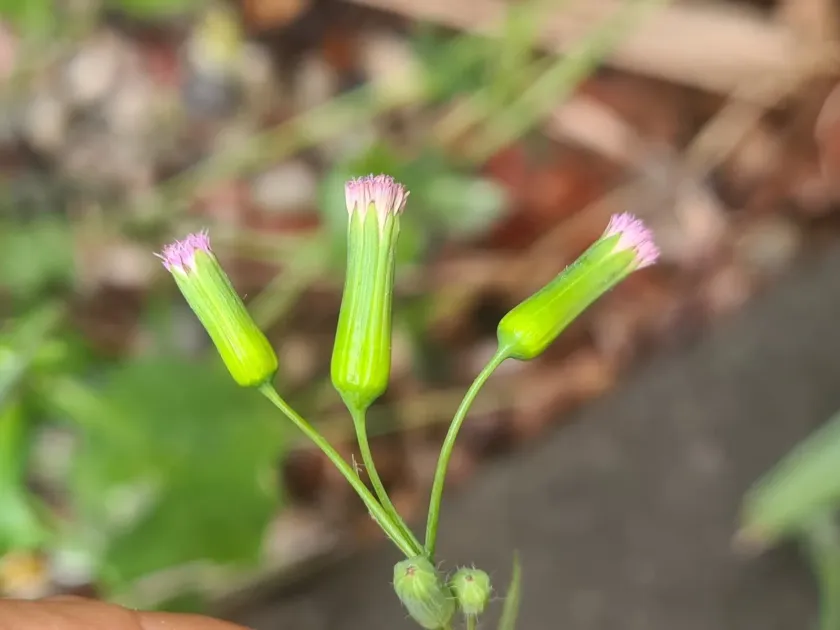
Emilia sonchifolia, commonly known as lilac tassel flower, is an annual herb belonging to the Asteraceae family. The plant typically features a branched stem reaching up to 50 cm, often with a reddish hue.
The leaves show significant variation: basal leaves are lyrate or pinnatifid, while upper leaves are smaller and stem-clasping, resembling the leaves of sow thistles.
Small flower heads are arranged on long, slender stalks. The florets are usually purple, pink, or red, making the plant easily distinguishable during the flowering phase.
The fruit is an achene equipped with a pappus of fine, soft hairs. This structure allows the seeds to be easily dispersed by the wind, ensuring rapid colonization of new areas.
The plant possesses a taproot system that enables it to compete effectively for water and nutrients against crops, even in competitive conditions.
Where it grows
Emilia sonchifolia is widely distributed across tropical and subtropical regions of Asia, Africa, and Australia, flourishing in warm climates.
It is commonly found on roadsides, waste lands, gardens, and neglected agricultural fields where it acts as a persistent colonizer.
The weed thrives in well-lit areas with fertile, moist soil, although it shows remarkable plasticity and can adapt to various environmental conditions.
In farming, it often infiltrates vegetable crops and grain fields, taking advantage of open soil spaces during the early crop growth stages.
It often acts as a pioneer species on disturbed soil, quickly establishing itself in areas where vegetation cover has been damaged.
Harm it causes
The primary damage caused by Emilia sonchifolia is its competitive nature, as it deprives crop plants of essential space, light, and soil minerals.
The weed serves as a significant host for various plant viruses, which are transmitted by insects to valuable agricultural crops, reducing total yield.
Its presence in fields interferes with mechanical farming operations and can contaminate harvested products, leading to lower market quality.
Due to its high seed production rate, the plant can quickly dominate large areas if not managed, becoming a difficult weed to eradicate.
The infiltration of this weed increases production costs, requiring additional labor for weeding or expenditures on chemical plant protection products.
How to control
Integrated weed management, including timely manual weeding and mechanical tillage, is highly effective in preventing seed production.
Implementing a balanced crop rotation system helps disrupt the lifecycle of Emilia sonchifolia, significantly lowering the seed bank in the soil.
The application of selective or non-selective herbicides is a standard chemical control method to eliminate the weed during its early growth stages.
Systemic herbicides are recommended in cases of heavy infestation to ensure the destruction of both the foliage and the root system.
Maintenance of field boundaries and surrounding areas is crucial to prevent the migration of wind-borne seeds into the primary cropping areas.
Taxonomy
- Latin name
- Emilia sonchifolia
- Family
- Сложноцветные (астровые)
- EPPO code
- EMISO