
Erechtites atkinsoniae
Erechtites atkinsoniae
Description
How to tell it apart
Erechtites atkinsoniae belongs to the Asteraceae family. It is a perennial herbaceous plant that often displays semi-shrub characteristics in favorable growing conditions.
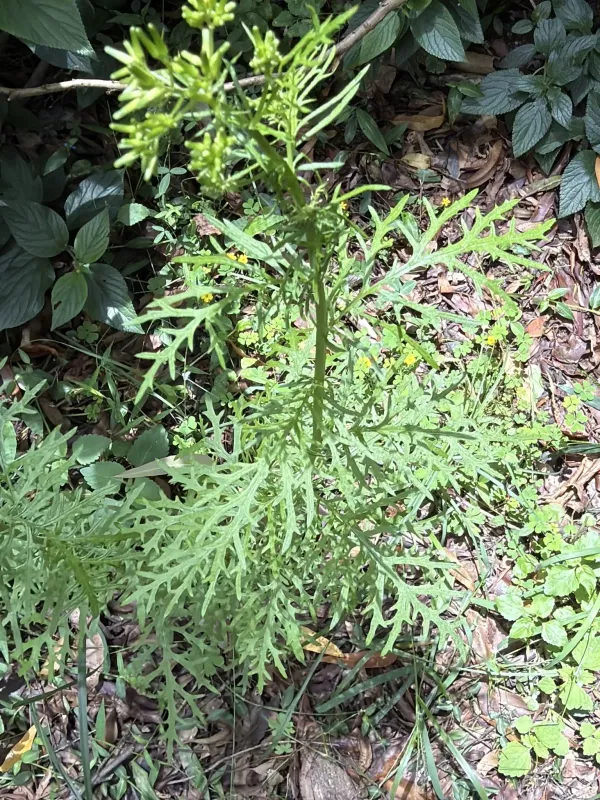
The plant features upright, slightly branched stems that can reach significant heights. Its leaves are alternate, lanceolate or serrated, often with noticeable pubescence on the undersides.
The inflorescences consist of flower heads arranged in loose panicles. The flowers are small, tubular, and typically yellowish or cream-colored, consistent with many members of the Asteraceae family.
The seeds are equipped with a feathery pappus, facilitating long-distance dispersal by wind currents, which allows the plant to colonize new agricultural areas rapidly.
The plant demonstrates high regenerative capacity, especially in its root system, which makes it challenging to eradicate once it has established a firm foothold in the soil.
Where it grows
Erechtites atkinsoniae typically colonizes disturbed ecosystems, forest edges, and roadsides. In agricultural settings, it is often found in fields adjacent to wooded areas or uncultivated land.
The species exhibits high adaptability to various soil types, including poor and acidic soils, allowing it to outcompete crops on land that requires intensive soil management.
It prefers regions with moderate to subtropical climates, where adequate air humidity supports vigorous biomass production during the spring and summer months.
It is commonly encountered in perennial forage crops, pastures, and orchards where minimal soil disturbance provides the ideal conditions for seed germination and seedling establishment.
Changes in crop rotation patterns and the abandonment of deep tillage can lead to this weed becoming the dominant species, suppressing valuable vegetation.
Harm it causes
The primary agricultural damage results from intense competition for water and soil nutrients, which significantly reduces the yield of cultivated crops in its vicinity.
The robust root system of Erechtites atkinsoniae inhibits the development of crop root systems, creating severe competition for minerals and moisture, which is critical during drought periods.
The plant exhibits allelopathic activity, releasing substances into the soil that suppress the germination and early development of crop seeds, leading to uneven stands and reduced growth.
Its presence in pastures reduces overall forage quality and may pose potential health risks to livestock if consumed, due to secondary metabolites typical of this family.
The rapid dispersal of seeds by wind creates a risk of infestation for neighboring fields, requiring coordinated control measures across large areas to effectively manage the population.
How to control
Agrotechnical management includes regular deep plowing, which serves to turn the soil and destroy rosettes, preventing them from re-establishing their root systems.
Timely mowing before the onset of flowering and seed maturation is crucial to prevent the spread of seeds across the field, which is the most effective way to curb the population.
Implementation of crop rotation using competitive cover crops can significantly reduce the density of Erechtites atkinsoniae by denying it essential sunlight and resources.
Chemical control is effective when using systemic herbicides targeting broadleaf weeds, though application must be strictly timed according to the growth stage of the main crop.
- Application of glyphosate-based products before crop planting.
- Use of selective post-emergence herbicides.
- Regular mechanical weeding in inter-row spaces.
- Ensuring seed purity to prevent accidental introduction of the weed.
Taxonomy
- Latin name
- Erechtites atkinsoniae
- Family
- Сложноцветные (астровые)
- EPPO code
- EREAT