
Devil's beggartick
Bidens frondosa
Description
How to tell it apart
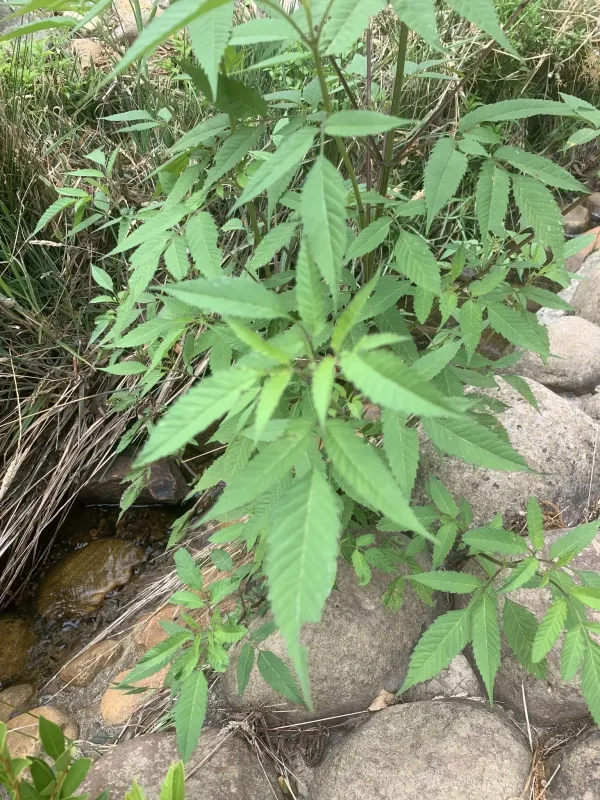
Devil's beggartick (Bidens frondosa) is an annual herbaceous plant belonging to the Asteraceae family. It features a branched stem that can grow up to one meter in height, often with a reddish tinge.
The leaves are opposite and pinnately compound, with lanceolate leaflets that have sharply serrated edges, giving them a distinct look.
Flower heads are arranged in loose clusters. The involucre of the flower head consists of leafy bracts that extend outward, making them look like small leaves.
The seeds (achenes) are flat and wedge-shaped, equipped with two barbed awns that easily attach to clothing, animal fur, or machinery for dispersal.
It possesses a strong taproot system, which helps it establish firmly in moist soils and compete effectively with agricultural crops.
Where it grows
This weed thrives in moist environments. It is commonly found along riverbanks, lakeshores, in wetlands, and in drainage ditches.
In agricultural settings, it frequently infests fields with poor drainage, as well as irrigated croplands where constant moisture is present.
It adapts well to fertile soils, making it a persistent problem in row crops like soybeans, corn, and various vegetable varieties.
The distribution of this species is expanding globally, as it easily hitches a ride with farm equipment and water runoff to new, suitable habitats.
Fields situated in floodplains or low-lying areas are particularly vulnerable to heavy infestations of Bidens frondosa.
Harm it causes
The primary damage caused by Devil's beggartick is its aggressive competition for water and soil nutrients, which directly suppresses crop yield.
Due to its rapid growth and high transpiration rates, it can cause water stress in crops during dry summer periods.
Dense infestations create significant shading, which reduces the photosynthetic efficiency of young crop plants, delaying their development.
The barbed seeds contaminate harvested grain, requiring extra costs for cleaning and potentially lowering the overall grade of the produce.
Furthermore, it acts as a secondary host for several insects and diseases that can negatively impact the health of surrounding crop plants.
How to control
Cultural control practices, such as deep plowing, are highly effective in burying seeds and preventing them from reaching the soil surface for germination.
Maintaining clean field borders and managing drainage ditches are essential to prevent the influx of seeds into the main production area.
Mechanical cultivation between crop rows should be performed regularly to eliminate seedlings before they reach the flowering stage.
Chemical control involves the use of selective herbicides designed to target broadleaf weeds, applied according to the manufacturer's growth stage guidelines.
- Implement crop rotation to break the life cycle.
- Use pre-emergence or post-emergence herbicide programs.
- Improve field drainage to reduce suitable habitats.
Taxonomy
- Latin name
- Bidens frondosa
- Family
- Сложноцветные (астровые)
- EPPO code
- BIDFR