

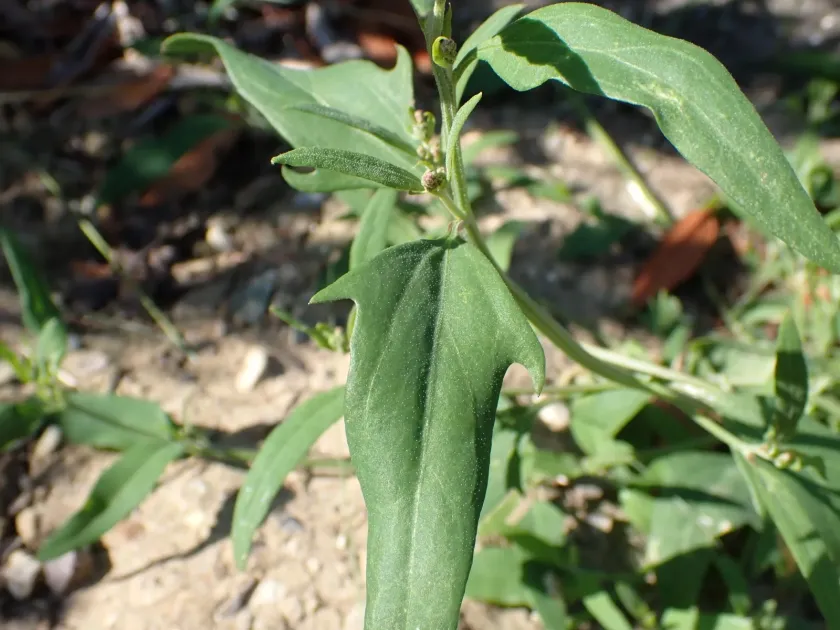
Description
How to tell it apart
Spreading orache, scientifically known as Atriplex patula, is an annual plant belonging to the Amaranthaceae family. It often grows as a sprawling or upright herb.
The leaves are characteristically triangular or spear-shaped, frequently featuring a mealy, silvery-white underside that helps in identification.
It possesses a strong, deep taproot system, which allows the plant to access nutrients and water, making it a very persistent competitor in agricultural fields.
The flowers are arranged in spike-like panicles at the ends of branches. Flowering generally occurs from early summer through late autumn.
The plant produces a vast number of seeds that can remain viable in the soil for many years, leading to a persistent seed bank problem for farmers.
Where it grows
Spreading orache is widely distributed across temperate regions worldwide. It is commonly found in arable fields, pastures, gardens, and disturbed land.
It thrives in nitrogen-rich, moist, and fertile soils, often appearing in areas where the natural soil structure has been disturbed by agricultural activity.
The plant is highly adaptable and can colonize various soil types, including saline environments where other competing plants might fail to establish.
It is frequently observed as a significant weed in cereal crops, row crops like sugar beets or maize, and vegetable production areas.
The weed spreads easily through soil cultivation tools, water runoff, and contaminated seeds, making it a difficult weed to eradicate completely.
Harm it causes
The primary impact of spreading orache is competition for sunlight, water, and essential soil nutrients, which directly limits the growth of crops.
Because of its rapid growth and large leaf surface area, it shades young crop seedlings, significantly reducing their potential for biomass accumulation.
It acts as an alternative host for various agricultural pests and viral diseases that can easily spread to nearby sensitive crop plants.
The contamination of harvested grains with orache seeds requires additional processing costs to meet quality standards for market or animal feed.
In cases of heavy infestation, the weed interferes with mechanical harvesting equipment, leading to increased equipment wear and reduced harvest efficiency.
How to control
Effective management requires an integrated approach that includes mechanical cultivation, competitive crop planting, and timely chemical application.
Cultural control methods such as crop rotation and the use of competitive cover crops can help suppress orache populations throughout the season.
Mechanical control, such as inter-row hoeing and pre-planting tillage, is highly effective if performed while the weed plants are still small and vulnerable.
- Implement diverse crop rotations.
- Perform timely mechanical inter-row cultivation.
- Use selective herbicides labeled for specific crop stages.
- Maintain weed-free field borders to prevent seed spreading.
Chemical control with systemic herbicides is most effective during the seedling stage, provided that environmental conditions allow for optimal uptake.
Content graph
Connections · Spreading orache
Most often together:
Marketplace
Products · 60


Biceps Guarant
ЗАТ Фірма Август, Росія.,селище Вурнари,
Herbicides
0
0
·
2.4K
8 offers
0.63 €per 1 l
Buy


Terramidin
Nanjing No.1 Pesticide Factory of Red Sun Group Co., Ltd.
Herbicides
0
0
·
1.1K
1 offer
7.61 €per 1 l
Buy


Herbicide «CORD»
«Нанджин Ессенс Файн-Кемікал Ко. Лтд» (Китай)
Herbicides
0
0
·
60
2 offers
57.42 €per 1 l
Buy


Nopasarán, KS (metazachlor, 375 g/l + imazamox, 25 g/l)
BASF Agro B.V.
Herbicides
0
0
·
51
2 offers
26.31 €per 1 l
Buy


BICEPS GUARANT K.E.
ЗАТ Фірма Август, Росія.,селище Вурнари,
Herbicides
0
0
·
40
1 offer
3.63 €per 1 l
Buy


Prima Forte, SE
Доу АгроСайенсіс С.А.С., Друзенхайм, Франція
Herbicides
0
0
·
33
18 offers
8.87 €per 1 l
Buy


CUPOL, WG
ТОВ «Фабрика агрохімікатів», Черкаси, Україна
Herbicides
0
0
·
29
1 offer
49.99 €per 1 l
Buy

TEZAN, RK (Bentazon, 480g/l)
ТОВ «Фабрика агрохімікатів», Черкаси, Україна
Herbicides
0
0
·
29
3 offers
7.5 €per 1 l
Buy

Protezhe, RC, (Bentazon, 560 g
Jiangsu Agricoem Laboratory Co., Ltd.
Herbicides
0
0
·
27
3 offers
9.57 €per 1 l
Buy

Bernar, RK (bentazon, 480 g/l)
Hefei Xingyu Chemical Co., Ltd.
Herbicides
0
0
·
25
2 offers
7.17 €per 1 l
Buy


Gerber
Superus Co., Ltd., Китай, Yangzhou Pioneer Chemical Co., Ltd., Китай
Herbicides
0
0
·
1.9K
No offers
—
Details


Belveder
Finkemü Schwebda, F.GmbH, GERMANY, MEMBER OF GROUP
Herbicides
0
0
·
872
No offers
—
Details


Greenwich w.p.c., (Bentazon 480 g/l)
China Chemical Industrial & Rice Co. Ltd
Herbicides
0
0
·
55
No offers
—
Details

Randeau, WG (triflusulfuron-methyl, 500 g/kg)
Аріста ЛайфСайенс С.А.С., Ногер, Франція
Herbicides
0
0
·
53
No offers
—
Details

Trimet-S
Ф.Нанджин Уссенс Файн-Кемікал Ко. Лтд. ,м.Черкаси. Україна.
Herbicides
0
0
·
51
No offers
—
Details


Biology
Taxonomy
- Latin name
- Atriplex patula
- Family
- Однолетние двудольные сорняки