


SKU #322
·
1 043 views
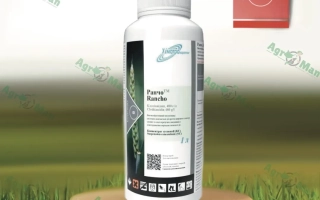
Compass 970
Herbicides, Desiccants
Garda Chemicals Ltd., F.User rating
0 votes0% positive reviews
No ratings yet — be the first.
Last Processing Date, Days
1
By Mode of Action
Selective herbicide
By Application Timing
Post-emergence herbicide
Form of the preparation
Water-soluble granules
About product

A high-performance selective systemic herbicide designed to control a broad spectrum of dicotyledonous weeds in cereal and maize crops.
Last Processing Date, Days
1
By Mode of Action
Selective herbicide
By Application Timing
Post-emergence herbicide
Form of the preparation
Water-soluble granules
Description
Effective Weed Control for Cereal Crops
«Compass 970» by the Indian manufacturer Garda Chemicals Ltd. is a selective systemic herbicide that has established itself as a reliable and cost-effective solution for modern intensive farming. Designed primarily for grain crops and maize, it serves as a robust defense against a wide array of problematic dicotyledonous weeds.
Key Features and Mode of Action
The active ingredient is Dicamba (in the form of dimethylamine salt), a benzoic acid derivative. As a systemic herbicide, it enters the plant through the foliage and travels to the meristematic tissues, effectively disrupting growth. This mechanism is particularly lethal to perennial root-sprouting weeds such as Cirsium arvense (field thistle) and Convolvulus arvensis (field bindweed).
Product Highlights
- Selective Action: Offers high safety for winter wheat and barley crops when applied according to recommended dosages.
- Targeted Weed Control: Highly effective against Chenopodium album, Sinapis arvensis, Capsella bursa-pastoris, and Stellaria media.
- Practical Formulation: The water-soluble granule (WG) format ensures easy mixing and reduces dust exposure during handling.
- Efficiency: With a usage rate of up to 0.5 l/ha, it provides an economically viable solution for large-scale application.
Application and Safety
As a post-emergence herbicide, Compass 970 is best utilized during the active growth phase of target weeds to ensure maximum translocation of the active ingredient. Classified under hazard class 3 with a short pre-harvest interval of just 1 day, it represents a balanced option for agronomists prioritizing both crop health and efficiency. By mitigating weed competition for nutrients and moisture early in the season, Compass 970 helps secure yield potential in cereal and maize cultivation.
Composition
Active ingredients
- Dicamba гербицид Производные бензойной кислоты
- Dicamba dimethylamine salt гербицид Производные бензойной кислоты
Application
Used on crops
Against weeds
Annual broadleaf weeds
Cocklebur
Common chickweed
Common fumitory
Common poppy
Creeping thistle
Euphorbiaceae
Field bindweed
Field forget-me-not
Flixweed
Jimsonweed
Knotweed
Perennial dicots
Poison hemlock
Ragweed
Resistant to 2,4-D
Scarlet pimpernel
Scentless mayweed
Shepherd's purse
Small Nettle
Spreading orache
Velvetleaf
Wild mustard
Wild radish
Specifications hover over for a hint about the specification
|
Last Processing Date, Days
Last Processing Date, Days
Number of days from processing to harvest cleanup |
1 |
|---|---|
|
By Mode of Action
By Mode of Action
Herbicides are divided into two groups according to their mode of action: Non-selective herbicides — intended for the destruction of all plant species. They are applied in agricultural fields during the absence of the main crop (after harvest, before crop emergence, on fallow lan... |
|
|
By Application Timing
By Application Timing
Herbicides are classified according to application timing into pre-emergent and post-emergent herbicides. Pre-emergent herbicides are mostly soil-applied or granular formulations applied before the emergence of crop plants. They are applied either pre-sowing (during pre-sowing cu... |
|
| Form of the preparation | |
|
Drug Consumption
Drug Consumption
Mass of the preparation per unit of treated area. It is customary to express the dosage rate in kilograms per hectare. The dosage rate is most often given in terms of 100% active ingredient, although sometimes it is calculated based on the preparation in the form of application w... |
Up to 0.5 L/ha |
| Danger Class | 3 |
|
By type of action
By type of action
Depending on their ability to move through living tissues, herbicides are divided into contact and systemic. Contact herbicides cause local damage to plant tissue upon contact, which dies or gradually degrades. This action does not always completely destroy the plant; often, its... |
|
|
By application method
By application method
Based on the method of application, herbicides are divided into foliar, soil, and root herbicides. Foliar herbicides are applied to vegetative plants and act through their above-ground organs. The main method of application for such preparations is spraying using sprayers or airp... |
|
| Registration year | 2012 |
| Catalog | Catalog → Herbicides, Desiccants |
| Manufacturer | Garda Chemicals Ltd., F. |
| Country | India |
Store offers
Prices are updated on loadLoading offers…
Aggregator catalog: prices are collected automatically from store websites, normalized by AI and converted at the current exchange rate. Before ordering, confirm the price and availability on the store's website. This block is not indexed by search engines — the data is loaded after the page opens.
Not yet комментариев. Be the first!
Alternatives
Herbicides, Desiccants · similar preparations






See also
Often considered together with this product


Recently viewed
Products you’ve viewed on this site
Reviews · 0