
Description
How to tell it apart
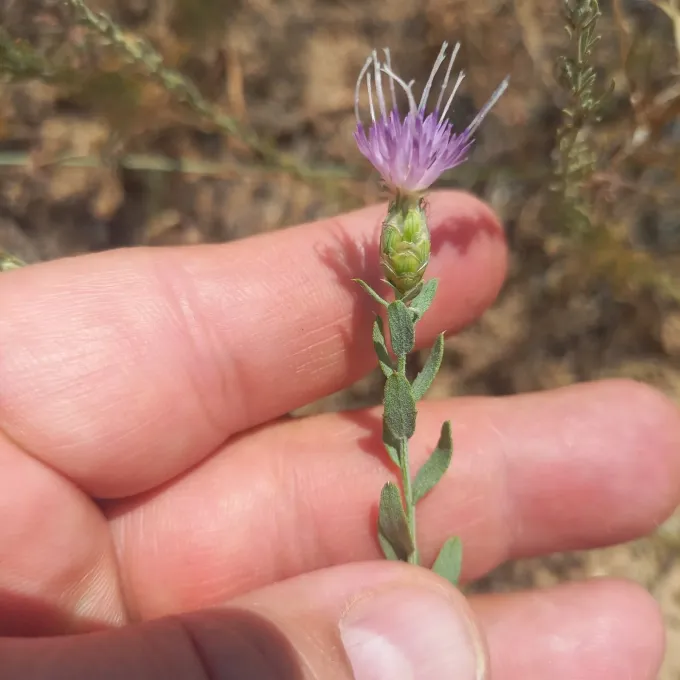
Russian knapweed is a deep-rooted perennial herb belonging to the Asteraceae family. It is characterized by its stiff, branched stems that can reach a height of up to 70 centimeters, covered in fine greyish hairs.
The leaves are alternate and lance-shaped with entire or slightly toothed margins. The plant is most easily identified by its small, urn-shaped flower heads that bloom with soft pink to lavender florets from late spring to summer.
The root system is the defining feature of the species, consisting of a complex network of horizontal and vertical roots. These roots can penetrate the soil to depths of 10 meters, making the plant exceptionally difficult to remove.
This species is highly persistent due to its ability to sprout new shoots from the root buds. A single fragment of the root, when distributed through tillage, can establish a new colony, facilitating rapid spread across fields.
Seeds are produced in large quantities and are equipped with a small pappus, allowing for wind dispersal. However, the vegetative spread via creeping roots remains the primary method by which this weed dominates agricultural environments.
Where it grows
Russian knapweed is widely distributed in arid and semi-arid regions. It thrives in various environments including crop fields, pastures, roadsides, and abandoned lands where it competes for limited water resources.
The plant is highly adaptable and shows a remarkable tolerance for different soil types, including saline and alkaline soils. It is particularly problematic in areas with poor drainage and disturbed soil conditions.
In agricultural settings, it frequently infests cereal crops, orchards, and alfalfa fields. Its rapid establishment allows it to form dense, monospecific patches that exclude virtually all other native or cultivated vegetation.
Russian knapweed often spreads into new areas through contaminated agricultural equipment and machinery. Once established, the underground root system creates a massive barrier for root penetration of desired crops.
The weed is known for its ability to survive extreme drought conditions, often outperforming crops during seasons with limited rainfall. This makes it a serious threat to productivity in dryland farming regions.
Harm it causes
The primary economic harm caused by Russian knapweed is the drastic reduction in crop yields. The plant effectively monopolizes soil moisture and nutrients, starving the surrounding crops of essential resources.
The weed exhibits allelopathic properties, releasing chemical substances into the soil that inhibit the growth and seed germination of surrounding plants, significantly reducing the density and health of crop stands.
Russian knapweed is toxic to horses and other livestock. While most cattle avoid grazing it due to its bitter taste, hay contaminated with the weed can lead to serious health issues, including neurological symptoms in horses.
Management costs associated with this weed are high, involving repeated chemical applications and intensive tillage operations. This increases production costs and reduces the overall profitability of the affected agricultural land.
Due to its invasive nature, it is classified as a noxious weed in many jurisdictions, which imposes strict legal requirements on landowners to contain and eradicate populations on their property.
How to control
Effective management requires an integrated approach. Cultural control methods include maintaining healthy competitive vegetation and utilizing crop rotation to suppress the establishment of new knapweed colonies.
Mechanical control, such as persistent cultivation, can be effective but must be carried out frequently to starve the root system. Infrequent tillage often stimulates root fragments to sprout, making the situation worse.
Chemical control is the most reliable method for large infestations. Systemic herbicides, particularly those based on picloram, clopyralid, or glyphosate, should be applied during the bud or flowering stage for maximum efficacy.
Spot treatment of patches is highly recommended to prevent the spread to unaffected areas. Early detection and rapid response are the most critical factors in keeping Russian knapweed populations under control.
- Regular monitoring of field margins and high-risk areas.
- Cleaning of machinery before moving between fields.
- Use of certified weed-free seed for planting.
- Combination of chemical and cultural suppression techniques.
Content graph
Connections · Russian knapweed
Most often together:
Marketplace
Products · 216


Alfa-Prometrin
Zhejiang Zhongshan Chemical Industry Group Co., Ltd.
Herbicides
1
1
·
3K
22 offers
0.48 €per 1 l
Buy



Torero
Finkemü Schwebda, F.GmbH, GERMANY, MEMBER OF GROUP
Herbicides
1
0
·
1.1K
2 offers
20.37 €per 1 l
Buy

Terramidin
Nanjing No.1 Pesticide Factory of Red Sun Group Co., Ltd.
Herbicides
0
0
·
1.1K
1 offer
7.61 €per 1 l
Buy


Consultant
Джянгсу Агрохем Лабораторі Ко. Лтд., Чанжоу, Китай
Herbicides
0
0
·
655
1 offer
5.68 €per pack
Buy


Bentazone 480 g/l, (Bentazone 480 g/l)
Sharda Worldwide Exports Pvt Ltd, Sharda World
Herbicides
0
0
·
72
2 offers
8.64 €per 1 l
Buy


Alfa-Brigadir
Jiangsu Good Harvest-Wayen Agrochemical Co., Ltd.
Herbicides
0
0
·
65
12 offers
8.49 €per 1 l
Buy


MASTAC, V.R., (CLOPIRACID, 300 G/L)
«Нанджин Ессенс Файн-Кемікал Ко. Лтд» (Китай)
Herbicides
0
0
·
61
1 offer
130.3 €per pack
Buy


DEFAULT
«Нанджин Ессенс Файн-Кемікал Ко. Лтд» (Китай)
Herbicides
0
0
·
58
3 offers
28.44 €per 1 l
Buy


Farmer, c.e., Oxiflufen
Санрайз Кемікалз Ко. Лтд., Шанхай, Китай
Herbicides
0
0
·
58
3 offers
26.03 €per 1 l
Buy


Grinfort DD 475
«Нанджин Ессенс Файн-Кемікал Ко. Лтд» (Китай)
Herbicides
0
0
·
55
1 offer
8.87 €per pack
Buy
Biology
Taxonomy
- Latin name
- Acroptilon repens
- Family
- Сложноцветные (астровые)
- EPPO code
- CENRE