
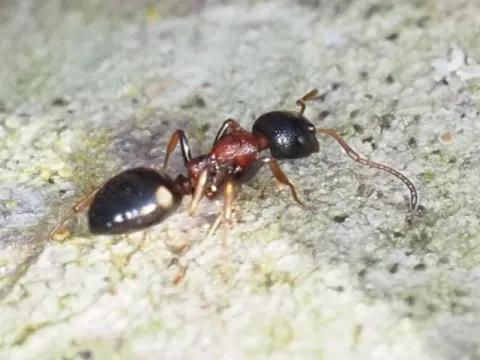
Four-spotted ant-carpenter
Dolichoderus quadripunctatus
The four-spotted ant-carpenter (Dolichoderus quadripunctatus) is a small species of the Formicidae family, measuring approximately 3–4 mm in length. Its body color ranges from dark brown to black.
What the section contains
Four-spotted ant-carpenter
The name comes from the four distinct light yellow spots located on the upper side of the abdomen. The head and thorax are characterized by dense hair covering, giving the insect a matte appearance.
These ants are primarily arboreal, meaning they prefer to live on trees. They often construct small, inconspicuous nests within bark fissures or hollows left by wood-boring insects.
They exhibit a polygynous lifestyle, often having multiple queens per colony. This social structure allows the population to recover quickly and expand its territory across a garden or orchard.
They maintain a strong symbiotic relationship with various hemipteran insects, primarily aphids and scale insects, which they farm for honeydew production.
While not a primary wood-destroyer, this ant species causes significant damage to orchard trees, including apple, pear, and cherry varieties, by protecting sap-sucking pests.
By protecting aphids from their natural predators, the ants enable aphid colonies to grow to destructive numbers, leading to leaf curling, stunted shoot growth, and fruit loss.
The persistent drain of sap by protected aphids weakens the tree's overall vigor, making it more susceptible to environmental stress and secondary infections.
These ants may expand existing bark cavities or wounds on tree trunks, which can facilitate the entry of fungal spores and wood-decaying organisms into the vascular system.
Their presence on the foliage is a reliable indicator of an underlying pest infestation that requires immediate agronomic intervention to prevent long-term damage.
The most visible sign of infestation is the consistent movement of ants along the tree trunk in defined trails heading toward the canopy where young leaves are located.
Heavy colonization of aphids on the growing tips of branches, surrounded by patrolling ants, is a definitive sign of their activity within your orchard.
Owners may notice small, paper-like structures built from wood debris and soil tucked into the crotches of branches or under loose bark, which serve as localized nesting sites.
A shiny, sticky substance known as honeydew covers the leaves, which often becomes colonized by sooty mold, creating a blackened appearance on the foliage.
At night, these ants are highly active and can be seen tending to their herds of aphids. Nighttime inspections with a flashlight are highly effective for detecting their presence.
The primary control strategy involves eliminating the aphid population. Applying systemic insecticides helps remove the food source, causing the ants to lose interest in the host tree.
Installing sticky bands (glue traps) around the tree trunk effectively blocks the ants' access to the canopy, protecting the foliage from their interference.
Sanitation practices, such as removing dead bark and pruning infested wood, destroy potential nesting sites and reduce the shelter available to the ant colonies.
Using slow-acting bait stations containing sugar-based solutions and low-toxicity insecticides allows worker ants to carry the poison back to the queen and larvae, eliminating the entire colony.
Encouraging the population of natural predators like ladybugs and lacewings helps suppress aphid numbers, thereby making the trees less attractive to the ants.