
Florida harvester ant
Pogonomyrmex badius
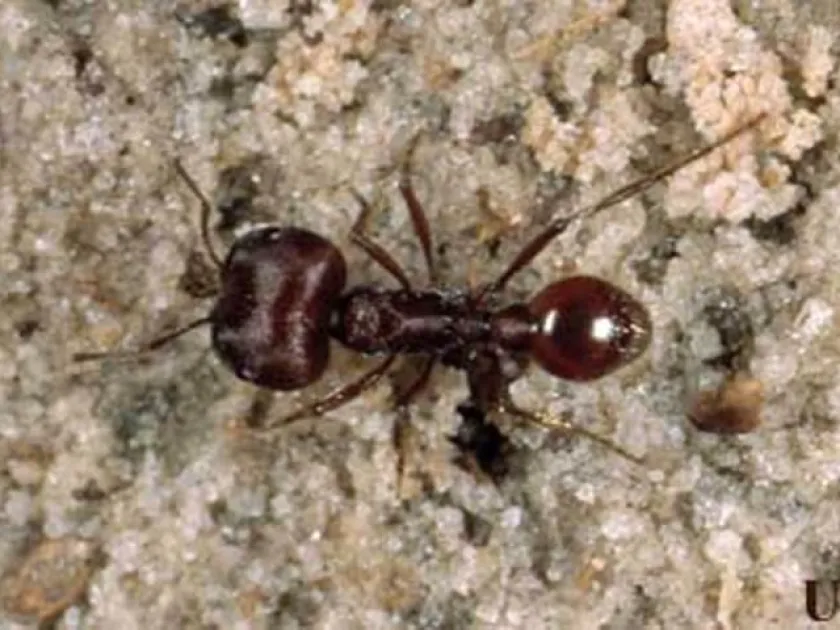
Description
How to identify
The Florida harvester ant (Pogonomyrmex badius) belongs to the order Hymenoptera, family Formicidae. It is the only member of the genus Pogonomyrmex native to the southeastern United States, adapted specifically to sandy soils.
Workers are characterized by a reddish-brown or orange color. This species is highly polymorphic, meaning workers come in different sizes, from small foragers to large-headed soldiers that specialize in cracking hard seeds.
Their nests are easily identified by large, sand-covered mounds. A signature trait is the cleared area around the entrance, where the ants have removed all vegetation to optimize foraging and nesting conditions.
The life cycle of the colony is robust, with a single queen capable of producing thousands of workers. These ants are highly organized and maintain extensive, deep tunnel systems that can reach several meters into the soil.
They are primarily seed-gatherers, dedicating their entire colony effort to collecting, storing, and processing various seeds, which provides them with a stable food source year-round.
What it damages
The primary agricultural damage is caused by the mass collection of seeds. When these ants infest agricultural fields, they can strip large areas of seeds, leading to significant yield loss and thin plant stands.
They also damage young seedlings. As plants emerge, the ants often cut the delicate stems or destroy the growing points, which inevitably leads to the death of the crop plant.
Beyond seed consumption, their tunneling activities disrupt the soil structure near the roots of crops. In sandy soils, this can lead to increased drying and instability for the plants.
The "cleared zones" around their nests result in barren patches in the field where no crop can grow, representing a direct loss of productive acreage for farmers.
While they provide some ecological benefit by dispersing seeds in natural habitats, in an intensive farming environment, they are considered significant pests due to their persistent interference with crop establishment.
When it appears
The Florida harvester ant is most active during the warmer months, typically from early spring through late autumn. Their foraging activity is highly temperature-dependent.
During the peak of the growing season, they are most aggressive in collecting seeds, aligning their activity with the harvest cycles of local grasses and the planting seasons of agricultural crops.
In the heat of the day, their activity may peak in the early morning and late afternoon hours, avoiding the most extreme surface temperatures of the sandy terrain.
As temperatures drop during the late fall, colony activity decreases significantly. They move deeper into the soil to escape surface fluctuations.
Winter is characterized by a low-metabolism state, where the colony remains dormant in the lower chambers of the nest until favorable temperatures return in the spring.
Signs of infestation
The most prominent sign of infestation is the presence of large sandy mounds, often encircled by a zone where all plant growth has been removed by the ants.
Foraging trails are frequently visible, appearing as distinct, cleared paths leading from the mound into the surrounding fields where the ants are actively harvesting.
Heaps of seed husks and discarded shells outside the nest entrances clearly indicate that the ants are processing gathered seeds in their internal storage chambers.
Patchy, uneven crop stands are common, where the ants have focused their harvesting efforts on newly planted seeds, leaving bare spots in the rows.
In very dry weather, signs of minor digging or disturbed soil around the base of plants can be observed as the ants attempt to optimize their foraging environment or seek moisture.
Control measures
The most effective strategy for managing these ants involves the use of toxic baits. These baits are collected by foraging workers and carried deep into the nest, eventually eliminating the queen.
Deep mechanical cultivation of the soil can destroy or severely disrupt the nest architecture, though this is often only a temporary measure as the colony may rebuild.
Applying repellent treatments or specialized insecticides to the seed coating during planting can protect crops from harvester ant attacks during the most vulnerable early growth stages.
Consistent monitoring and early detection are crucial. Identifying nests before they expand into large colonies allows for more localized and efficient control efforts.
- Targeted application of granular insecticides to nest entrances.
- Implementation of weed control to reduce natural seed sources that attract ants to the field.
- Integration of irrigation to maintain soil moisture, which makes the sandy habitat less attractive to the colony.
Taxonomy
- Latin name
- Pogonomyrmex badius
- Order
- Hymenoptera
- Family
- Formicidae
- EPPO code
- POGOBD
Discussion
No discussions yet — be the first.