
Florida carpenter ant
Camponotus floridanus
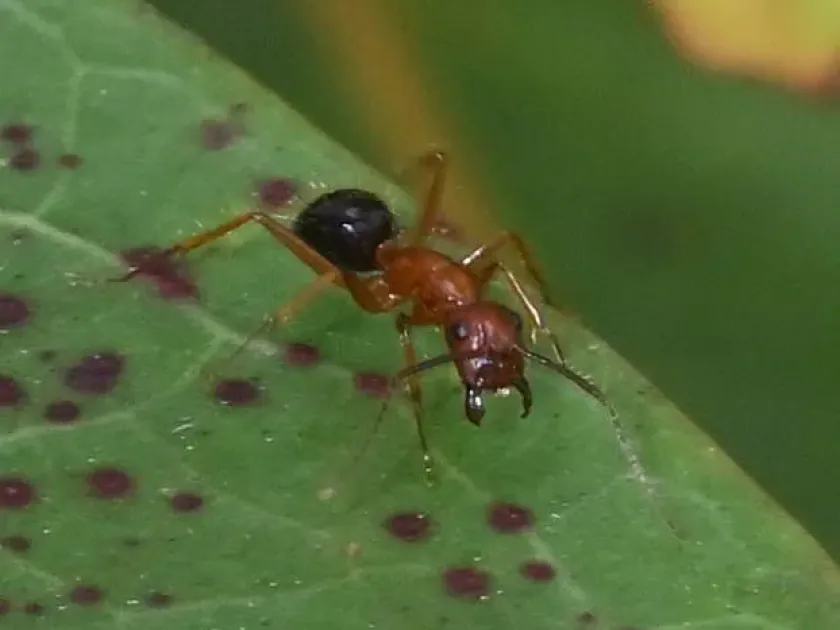
Description
How to identify
The Florida carpenter ant (Camponotus floridanus) belongs to the order Hymenoptera and the family Formicidae. These are large ants, with worker individuals typically measuring between 6 and 10 mm in length.
They are characterized by a distinct reddish-orange thorax, while their head and abdomen are much darker, often black. Their bodies are covered with scattered but stiff, coarse hairs.
These ants do not possess a stinger; however, they can bite and spray formic acid from their abdomen, which causes a stinging sensation if it comes into contact with human skin.
The colonies typically nest in moist or decaying wood, tree cavities, or even in the soil, which makes locating the primary nest a challenging task for growers.
They exhibit polymorphic social structures, meaning that workers can vary significantly in size depending on their specific role within the colony hierarchy.
What it damages
Florida carpenter ants cause primary damage to fruit trees and ornamental plants by excavating galleries inside the trunks and branches for their nests.
Although they do not feed on the wood itself, their nesting activity hollows out the woody tissues, which structurally weakens the tree and makes it susceptible to wind damage.
A significant aspect of their harmfulness is the protection of aphids and scale insects, as the ants feed on the honeydew these pests produce and actively guard them from natural predators.
The galleries created by the ants act as entry points for fungal pathogens and wood-rotting bacteria, which can cause internal decay of the tree's vascular system.
In cases of severe infestation, the tree may suffer from reduced nutrient flow, leading to stunted growth, dieback, or even the eventual death of the entire plant.
When it appears
The activity of the Florida carpenter ant is highly dependent on ambient temperature, making them most active during the warmer months, typically from spring through autumn.
During the winter season, the colony enters a state of dormancy, remaining deep within their galleries in wood or soil to survive the cooler temperatures.
Emergence and the start of active foraging typically coincide with the arrival of stable spring weather when temperatures consistently remain above 15–18 degrees Celsius.
Workers are primarily nocturnal foragers, meaning they are most likely to be seen traveling along tree branches or along the ground during the night in search of food.
The reproductive flight of winged individuals, aimed at establishing new colonies, usually occurs in the late spring or early summer, which is a critical time for monitoring.
Signs of infestation
The presence of "frass"—a mixture of sawdust and debris pushed out of nesting galleries—at the base of a tree is the most reliable sign of an active carpenter ant infestation.
Observing well-defined ant trails leading from the ground up to the tree canopy or towards colonies of aphids is a classic indicator of their foraging activity.
Small, circular exit holes on the surface of the bark or woody stems indicate that the ants have established a mature system of galleries within the tree.
A persistent presence of honeydew-secreting pests (like aphids) on a plant, despite chemical treatments, often means that carpenter ants are actively defending these pests.
Hollow or "drumming" sounds when tapping on the trunk or large limbs indicate significant internal structural damage caused by the ants' excavation.
Control measures
Using slow-acting toxic baits is the most effective management strategy, as foragers carry the poison back to the nest, eliminating the queen and the brood.
Managing the aphid and scale insect population is crucial, as removing the primary food source of the ants forces them to seek resources elsewhere.
Mechanical removal of decaying wood and treating tree wounds with appropriate sealants can prevent the ants from expanding their nesting galleries.
Applying sticky adhesive bands around the trunks of trees acts as a physical barrier, preventing ants from reaching the canopy and tending to aphids.
- Utilize gel-based insecticides that are attractive to the ants.
- Practice regular sanitary pruning to remove dead or diseased branches.
- Maintain garden hygiene to reduce nesting opportunities in rotting organic matter.
Taxonomy
- Latin name
- Camponotus floridanus
- Order
- Hymenoptera
- Family
- Formicidae
- EPPO code
- CAMOAF
Discussion
No discussions yet — be the first.