
Green tree ant
Oecophylla virescens
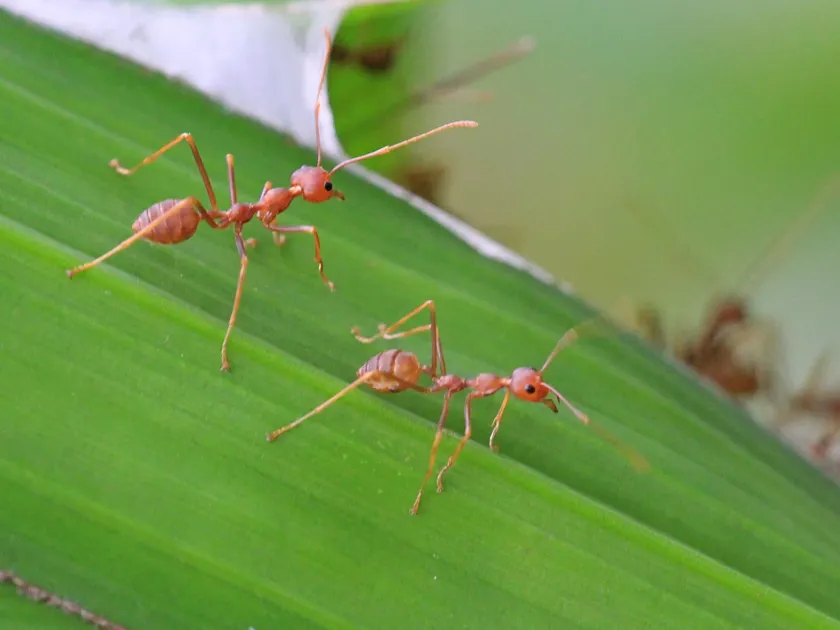
Description
How to identify
The green tree ant (Oecophylla virescens) is a large, highly social insect belonging to the family Formicidae. They are known for their distinct yellowish-green or reddish coloration and slender body structure.
These ants are famous for their unique nest-building behavior. They use their own larvae as "living glue guns," producing silk that binds leaves together to form complex, multi-layered nests within the tree canopy.
Colonies are extremely aggressive and territorial. A single colony can span multiple trees and contain thousands of workers who work together to protect their home against any intruders, including humans.
Reproduction is continuous, as these ants thrive in tropical environments. The queen is the reproductive heart of the colony, ensuring a constant supply of worker ants to expand the nest system.
Possessing powerful mandibles, they are capable of delivering painful bites. They often spray formic acid into the wound, which causes a sharp stinging sensation, further discouraging predators and agricultural workers.
What it damages
The primary agricultural damage caused by green tree ants is their mutualistic relationship with sap-sucking pests like aphids, scale insects, and mealybugs. They actively "farm" these pests to obtain honeydew.
By protecting aphids and scale insects from natural predators like ladybirds and wasps, the ants allow these pests to proliferate uncontrollably. This leads to heavy sap loss in the host plant.
The honeydew excreted by these sap-sucking pests encourages the growth of sooty mold, a fungus that covers the leaf surface. This layer of mold severely inhibits photosynthesis, weakening the tree.
Extensive infestations can lead to stunted growth, yellowing leaves, and significant yield loss. Fruit quality often degrades as the tree struggles to maintain its health under the constant stress of pests.
Furthermore, their aggressive nature makes it difficult for farmers to perform maintenance or harvest crops. The presence of these ants can render entire orchard sections inaccessible for routine care.
Signs of infestation
The most visible sign of an infestation is the presence of nests made from live leaves. These leaves are curled and stitched together with white, silken threads produced by the ant larvae.
Constant ant trails are observed along the branches and trunks. These highways are used by workers to move between food sources and patrol the tree's surface against potential threats.
A heavy concentration of aphids or scale insects on new shoots or the underside of leaves is a strong indicator of an ant-tended population, as the ants actively shield them from being eaten.
The presence of sticky honeydew or a black, powdery coating of sooty mold on the foliage suggests that the tree is currently supporting a colony of sap-sucking insects managed by the ants.
Aggressive defensive behavior is another sign; if a branch is disturbed, the ants will immediately swarm out of their nests and off the branches, attacking anything that moves within their territory.
Control measures
Management focuses on disrupting the bond between ants and their sap-sucking partners. Applying systemic insecticides to control aphids and mealybugs often causes the ants to abandon the tree.
Mechanical barriers, such as non-drying sticky bands applied around tree trunks, effectively block ants from climbing. This prevents them from tending to pests and forces a reduction in the aphid population.
For chemical control, slow-acting toxic baits are highly effective. When foraged by workers and brought back into the nest, they can eliminate the entire colony, including the queen and brood.
Sanitation is key; pruning infested branches during the early stages of colony formation can physically remove the ants and their nursery sites before they expand across the entire orchard.
Promoting a diverse ecosystem by encouraging natural predators, such as predatory beetles and lacewings, helps suppress the pest population that the ants rely on, ultimately making the trees less attractive.
Taxonomy
- Latin name
- Oecophylla virescens
- Order
- Hymenoptera
- Family
- Formicidae
- EPPO code
- OECOVI
Discussion
No discussions yet — be the first.