

Strawberry mite
Phytonemus pallidus
Description
How to identify
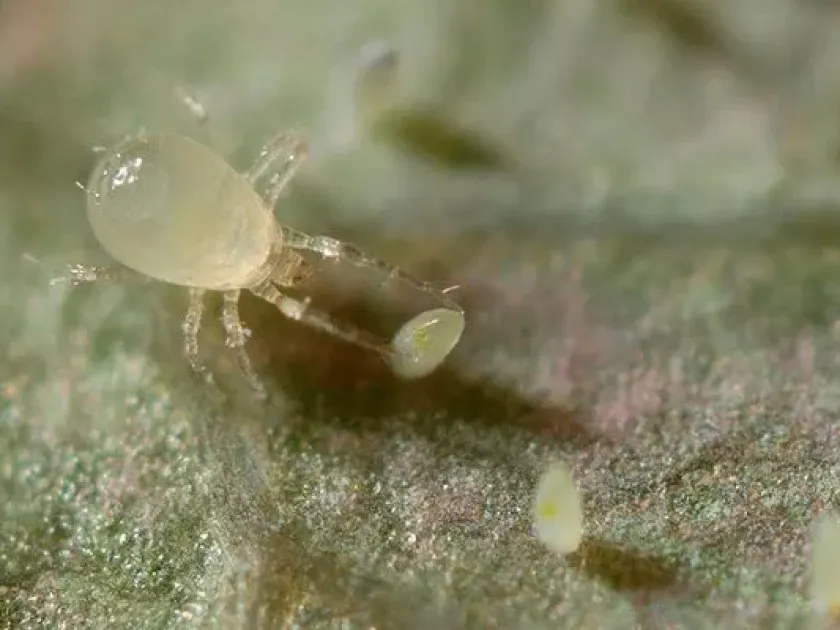
The strawberry mite (Phytonemus pallidus) is a member of the Tarsonemidae family, order Acariformes. It is a microscopic pest that is almost invisible to the naked eye, measuring approximately 0.2 mm in length.
The mite has an elongated, translucent body that is pale yellow. Its life cycle is highly dependent on environmental conditions, particularly humidity and moderate temperatures.
Adults and larvae congregate in the youngest, tightly folded leaves in the center of the crown, where they are protected from direct sunlight and predators.
The development cycle from egg to adult takes between 10 and 20 days, allowing for multiple generations to occur throughout the growing season.
Fertilized females overwinter in the base of the leaf petioles, seeking refuge in the crowns of strawberry plants to survive cold temperatures.
What it damages
The primary host is the garden strawberry, but the mite can also infest various greenhouse crops, including cyclamens and chrysanthemums.
The mites feed by sucking sap from the young, developing foliage, which disrupts normal plant metabolism and weakens the overall immune system of the host.
Damage to the apical buds causes severe stunted growth. Affected plants often appear dwarfed and fail to produce a viable crop.
Infested plantations exhibit significantly reduced winter hardiness, leading to higher rates of plant mortality during cold winter months.
In terms of economic impact, heavy infestations can reduce yields by up to 70%, resulting in small, distorted fruit that is unsuitable for market sale.
When it appears
Activity begins in early spring as soon as average daily temperatures consistently reach +10°C to +12°C.
The population density usually peaks during the second half of summer, favored by high humidity (over 80%) and moderate temperatures around +20°C.
While extremely hot and dry weather slows down reproduction, the mites do not die; instead, they retreat deeper into the plant crown to wait for cooler, more humid conditions.
Spread between plants occurs primarily through contaminated nursery stock, farm tools, or human activity during routine maintenance.
As autumn approaches, the mites prepare for dormancy, clustering at the base of the strawberry rosettes to survive the winter season.
Signs of infestation
Infested leaves exhibit a characteristic oily, yellowish-green appearance and become severely crinkled or distorted at the edges.
The center of the plant appears stunted, and new leaflets often fail to unfold properly, remaining trapped in a tightly twisted state.
Petiole length is significantly reduced, giving the plant a flattened appearance compared to healthy, vigorous specimens.
- Oily sheen on foliage.
- Distorted and crinkled leaf margins.
- Stunted plant growth.
- Small and deformed berries.
Because the mites are too small to see without a microscope, diagnosis is typically based on the visible physiological deformations of the host plant.
Control measures
Always use high-quality, certified nursery stock to prevent introducing the pest into new strawberry plantations.
Perform a hot water treatment on new seedlings before planting by immersing them in water at +45°C to +48°C for 15 minutes to eliminate mites.
Apply systemic acaricides during critical periods, specifically early in the growing season before flowering and immediately after the final harvest.
Rogue out and destroy heavily infested plants as soon as symptoms appear to prevent the colony from spreading to healthy rows.
Maintain proper plant spacing and good air circulation within the field, as high humidity and dense canopies facilitate rapid mite population growth.
Content graph
Connections · Strawberry mite
Most often together:
Marketplace
Products · 17





Biology
Taxonomy
- Latin name
- Phytonemus pallidus
- Order
- Mites
- Family
- Tarsonemidae
- EPPO code
- TARSPA
Community
Discussion
No discussions yet — be the first.