
Broad mite
Polyphagotarsonemus latus
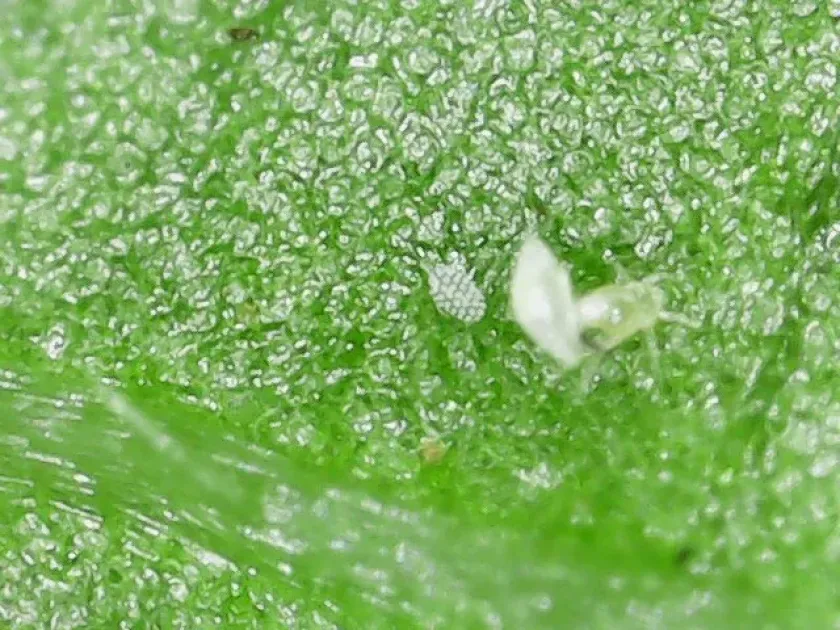
Description
How to identify
The Broad mite, known scientifically as Polyphagotarsonemus latus, is a member of the Tarsonemidae family. It is a microscopic pest, with adults measuring only 0.1 to 0.2 mm, making them nearly invisible without magnification.
Adult females are oval-shaped and range from yellow to pale brown, while males are slightly smaller and more active. They tend to congregate in high-humidity areas, particularly on the undersides of young leaves and inside developing buds.
Their life cycle is remarkably short, completing from egg to adult in about 4 to 7 days under ideal conditions. This rapid turnover leads to massive population explosions in very short periods if left unchecked.
The mite thrives in warm, humid conditions typical of greenhouse environments. Temperatures around 20-25 degrees Celsius and high humidity levels provide the perfect breeding ground for their continuous development.
Dispersal within a crop or greenhouse occurs through contact, infested plant material, wind currents, and equipment. Because they are so small, they can easily hitchhike on personnel and tools without detection.
What it damages
The Broad mite is a highly polyphagous pest, meaning it attacks a wide variety of plants including peppers, cucumbers, citrus, grapes, and many ornamental species. Few crops are immune to its feeding habits.
These mites feed by piercing plant cells and injecting toxic saliva. This chemical causes abnormal cell growth and profound developmental issues, often leading to severe stunting of the plant's growth points.
Typical damage includes curled, twisted, and brittle foliage. Affected leaves often exhibit a bronze or silver metallic sheen, and the tissue can become hardened or corky over time due to the feeding trauma.
When buds or flowers are attacked, they often abort or produce distorted fruit and blooms. This damage is catastrophic for yield and market value, as deformed produce is usually unsellable in commercial markets.
In severe infestations, the entire terminal growth of the plant can turn black and necrotic, essentially stopping the plant from developing further. This can lead to total crop failure if intervention is delayed.
Signs of infestation
The first signs are usually found at the very top of the plant, where growth is most active. Look for leaves that start to curl downwards or appear thicker and more distorted than healthy foliage.
A shiny, greasy appearance on the leaf surface is a telltale sign. As the infestation progresses, this area often turns brown or necrotic, and the leaves may feel brittle and snap easily when handled.
Shortened internodes cause the plant to appear bushy or stunted, which is sometimes mistaken for physiological disorders or viral infections. A lack of proper diagnosis often leads to ineffective treatment approaches.
The presence of eggs is a definitive indicator. Under a high-powered microscope, you can see distinct, oval-shaped eggs on the underside of young leaves, which often appear to have tiny white spots or bumps.
If you observe a sudden stop in new leaf growth combined with leaf curling and hardening, you should immediately investigate for the presence of these mites using a strong magnifying lens.
Control measures
Strict quarantine procedures for incoming plant material are essential to prevent the introduction of the pest. Always inspect new plants carefully before placing them in the main growing area.
Cultural control measures, such as maintaining good airflow, proper spacing, and managing humidity levels, can help discourage mite populations, although these are rarely enough on their own to stop an established colony.
Chemical control must involve specialized acaricides, as standard insecticides are often ineffective against tarsonemid mites. It is crucial to rotate chemical modes of action to prevent the development of resistance.
Biological control is highly successful in protected cropping systems. Releasing predatory mites such as Neoseiulus californicus or Amblyseius swirskii can significantly reduce Broad mite numbers without relying on harsh chemicals.
- Remove and destroy highly infested plants.
- Use specific acaricides targeted at mites.
- Sanitize tools and surfaces after handling infested plants.
- Monitor the crop frequently with a 20x magnification lens.
- Implement biological controls early in the season.
Taxonomy
- Latin name
- Polyphagotarsonemus latus
- Order
- Mites
- Family
- Tarsonemidae
- EPPO code
- HEMTLA
Discussion
No discussions yet — be the first.