
Broad mite
Hemitarsonemus
Description
How to identify
The broad mite (Polyphagotarsonemus latus, formerly known as Hemitarsonemus latus) is a microscopic pest belonging to the Tarsonemidae family.
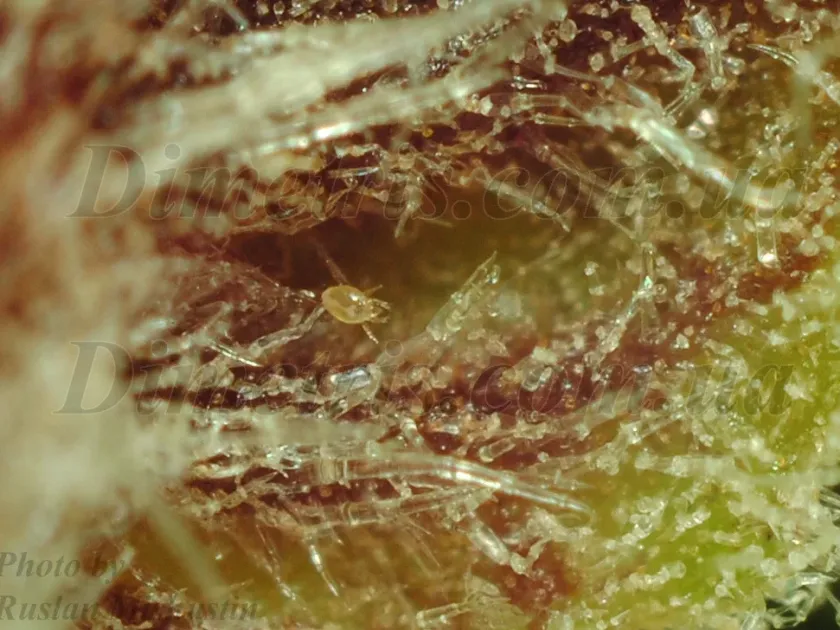
Measuring only about 0.1–0.2 mm in length, these pests are nearly invisible to the naked eye, appearing as tiny, translucent, oval-shaped entities.
They progress through four developmental stages: egg, larva, nymph (pupa), and adult, with the entire cycle completing in just 4 to 7 days.
Females are highly prolific and typically deposit their eggs in sheltered areas, particularly on the underside of young leaves and inside apical buds.
Due to their minute size and rapid lifecycle, infestations often remain unnoticed until severe damage has already occurred to the host plants.
What it damages
Broad mites are major pests with a wide host range, frequently damaging vegetables, ornamental plants, and various fruit-bearing crops.
They feed by extracting cellular sap from developing tissues, which causes the plant to lose vitality and exhibit stunted growth patterns.
The feeding process results in severe leaf deformation, characterized by curling, wrinkling, and a toughened, corky appearance of the tissues.
In addition to structural damage, the mites can inject toxic substances during feeding, which permanently arrests the growth of terminal buds.
Heavy infestations on susceptible crops like peppers or cucumbers can lead to complete yield loss if not managed in the early stages.
When it appears
In greenhouse environments, broad mites are active year-round, provided that temperature and humidity levels remain within their preferred range.
They thrive in warm conditions, with optimal development occurring at temperatures between 20°C and 28°C and high relative humidity above 80%.
Outdoors, the mites become problematic during the warmer months, often spreading through wind currents or via the movement of infested plant material.
There is no specific diapause for this pest in heated greenhouses, allowing them to maintain continuous populations across different crop cycles.
Regular monitoring is critical during spring and summer months when rapid population growth coincides with periods of peak vegetative growth.
Signs of infestation
Symptoms often resemble viral infections or herbicide drift, making correct identification essential for implementing the right management strategy.
Affected leaves usually curl downward and become hardened, with the underside sometimes showing a characteristic metallic or silvery sheen.
Flowers and fruit are frequently malformed, and internal damage to the growing point often results in a rosette or bushy appearance of the plant.
Flower buds often drop prematurely, and the overall plant growth becomes stunted, resulting in smaller and poorer quality yields.
- Darkening or bronzing of tender plant parts.
- Severe twisting and distortion of terminal leaves.
- Significant shortening of internodes.
Control measures
Managing broad mites requires specific acaricides, as many standard insecticides do not provide adequate control against this family of mites.
Resistance management is key; therefore, growers should rotate products with different modes of action to ensure long-term efficacy.
Sanitation is a vital component of integrated pest management, including the removal of weeds and debris that can serve as alternative hosts.
Biological control using predatory mites, such as Amblyseius swirskii, has proven successful in reducing mite populations in protected agriculture.
Always inspect new plant material thoroughly before introduction to a clean greenhouse to prevent the initial entry of the pest.
Taxonomy
- Latin name
- Hemitarsonemus
- Order
- Mites
- Family
- Tarsonemidae
- EPPO code
- HEMTSP
Discussion
No discussions yet — be the first.