

Root-knot nematode
Meloidogyne incognita
Description
How to identify
The root-knot nematode (Meloidogyne incognita) is a microscopic worm classified under the phylum Nematoda, class Secernentea, order Tylenchida, and family Meloidogynidae.
Adult females are sedentary, pear-shaped endoparasites that spend their entire reproductive life cycle embedded within the host plant's root tissue.
In contrast, males are vermiform and are capable of movement within the soil, though they are rarely observed compared to the females.
The second-stage juvenile is the only infective stage, possessing the ability to migrate through the soil film to locate and penetrate host roots.
Identification often requires careful inspection of the root system and, in formal diagnostic cases, analysis of the female's perineal pattern using microscopy.
What it damages
This species is a highly polyphagous pest capable of infecting thousands of different plant species, including major global food crops.
It causes significant economic losses in greenhouses where conditions are consistently favorable for its rapid reproduction and spread.
Vegetable crops such as tomatoes, cucumbers, and peppers are particularly susceptible to severe infestations, which can lead to total crop failure.
By invading the roots, the nematodes disrupt the plant's vascular system, preventing the efficient uptake of water and essential mineral nutrients.
Furthermore, the physical damage to the roots creates entry points for various soil-borne pathogens, leading to complex disease syndromes.
When it appears
The activity and lifecycle speed of Meloidogyne incognita are heavily dependent on soil temperature, with 25°C to 30°C being optimal.
The nematode's development slows significantly as soil temperatures drop, but they can survive unfavorable conditions in the soil as eggs.
In temperature-controlled environments like greenhouses, the nematode can complete a full generation in as little as 25 to 30 days.
Dispersal across fields primarily occurs through the movement of infested soil on farm equipment, contaminated irrigation water, and infected transplant stock.
Field infestations are most problematic during warmer seasons when temperatures allow for the rapid transition of juveniles from the soil to the roots.
Signs of infestation
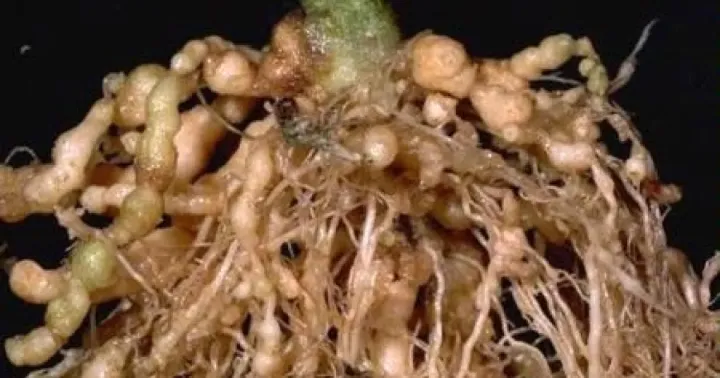
The hallmark symptom of infestation is the formation of galls (knots) on the roots, which are caused by the nematode's interference with plant cell growth.
Above-ground symptoms often include stunted growth, wilting during peak sunlight hours, and generalized chlorosis, even when irrigation is adequate.
The root system appears distorted and may exhibit excessive branching as the plant attempts to compensate for the damaged conductive tissues.
In severe cases, plants may exhibit symptoms of nutrient deficiency because the compromised root system can no longer supply the necessary resources.
- Characteristic knots or galls on the root system.
- Wilting and drooping leaves during the day.
- Significant stunting and reduced plant vigor.
- Increased sensitivity to drought and environmental stress.
Control measures
Implementing a strict crop rotation strategy using non-host or resistant plant varieties is a primary method for reducing nematode populations in the soil.
Preventive measures include the use of certified nematode-free seedlings and the thorough sanitization of all farm tools and greenhouse surfaces.
Soil solarization or steam pasteurization are effective physical methods used to eradicate high concentrations of nematodes in greenhouse soil beds.
Biological control agents, such as beneficial fungi (e.g., Paecilomyces lilacinus), can be applied to suppress nematode numbers naturally.
Post-harvest management involves the removal and destruction of all infested root debris to prevent the buildup of eggs and juveniles in the soil.
Content graph
Connections · Root-knot nematode
Most often together:
Marketplace
Products · 137














Biology
Taxonomy
- Latin name
- Meloidogyne incognita
- Order
- Nematodes
- Family
- Meloidogynidae
- EPPO code
- MELGIA
Community
Discussion
No discussions yet — be the first.