
African gall nematode
Meloidogyne acronea
Description
How to identify
The African gall nematode, Meloidogyne acronea, is a species of plant-parasitic nematode within the family Meloidogynidae. It is a microscopic soil-borne pest that requires a living plant host to complete its lifecycle.
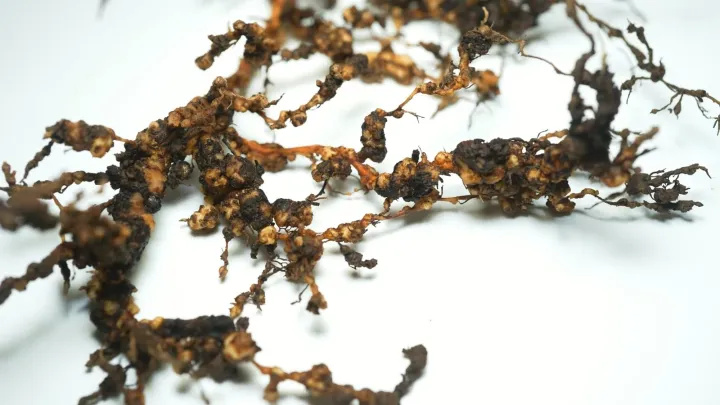
Female nematodes are endoparasitic, meaning they embed themselves within the root tissue of the host plant, where they feed and develop into a sedentary, swollen form.
Identification typically requires expert morphological examination of the perineal pattern and stylet structure, as they often appear similar to other related root-knot species under low magnification.
The life cycle involves an egg stage, four larval stages, and an adult stage. Second-stage juveniles are the primary infective stage, capable of migrating through the soil to find a suitable host root.
Reproduction is largely asexual via parthenogenesis, allowing the population density to increase rapidly under favorable temperature and moisture conditions.
What it damages
Cotton is a primary host for Meloidogyne acronea, where it causes significant disruption to the root system, ultimately leading to reduced crop yields.
The nematode has a host range that includes various weed species, which can act as reservoirs, maintaining the nematode population during fallow periods or crop rotation.
Feeding by the nematode causes cellular hypertrophy in the roots, interfering with the plant's ability to transport water and essential mineral nutrients from the soil.
The resulting damage often predisposes the root system to invasion by secondary pathogens, such as soil-borne fungi and bacteria, which can exacerbate plant stress.
High infestation levels lead to stunted crop growth, significant biomass reduction, and substantial economic losses in affected agricultural regions.
Signs of infestation
Symptoms of infestation are usually first noticed as patchy areas in a field where plants appear significantly smaller and less vigorous than healthy counterparts.
Plants often exhibit symptoms of wilting during the hottest part of the day, even when soil moisture appears adequate, indicating impaired root function.
A diagnostic sign is the presence of root galls or swellings, although these may be less pronounced than in other Meloidogyne species, and may be accompanied by reduced root branching.
Chlorosis and leaf yellowing are common secondary symptoms due to the plant's inability to uptake sufficient nutrients to maintain healthy foliage.
Yield reduction is the most critical field sign, where harvestable product output is noticeably lower on infested patches compared to non-infested fields.
Control measures
Crop rotation with non-host plants is the most sustainable strategy for reducing soil populations of Meloidogyne acronea over time.
Cultural practices, including thorough cultivation and the removal of host weeds, help minimize the nematode's ability to survive between seasons.
The use of certified disease-free seeds and the planting of resistant crop varieties remain the most effective long-term defense against nematode damage.
Chemical control via soil fumigants or systemic nematicides is possible but is generally reserved for severe infestations due to cost and environmental considerations.
Sanitation is vital; farmers should clean farm equipment before moving from infested fields to clean ones to prevent the spread of soil-borne nematodes.
Taxonomy
- Latin name
- Meloidogyne acronea
- Order
- Nematodes
- Family
- Meloidogynidae
- EPPO code
- MELGAC
Discussion
No discussions yet — be the first.