

Pest · Coleoptera (beetles) · affects Winter wheat, Winter barley, Potato
Cereal flea beetle
Chaetocnema
Description
How to identify
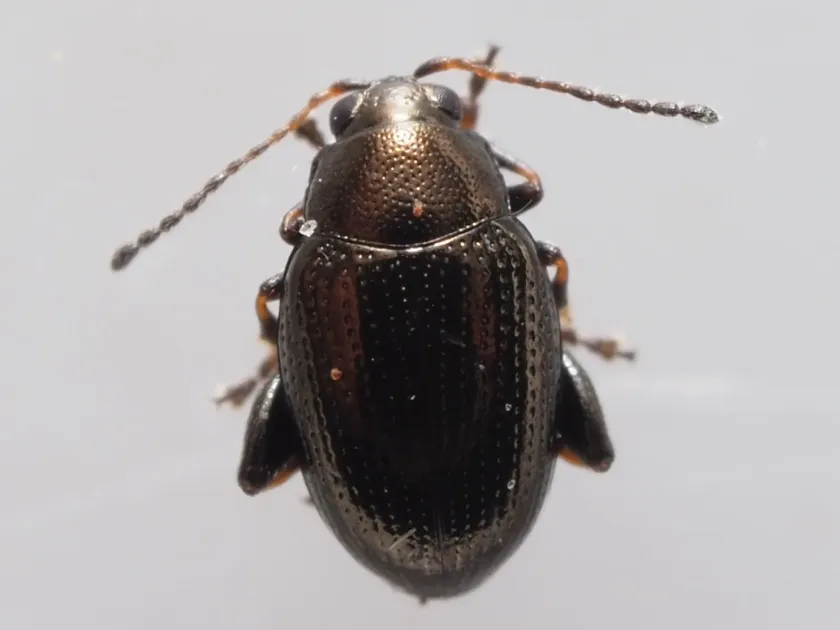
Cereal flea beetles (genus Chaetocnema) belong to the leaf beetle family (Chrysomelidae) within the order Coleoptera. These are small, jumping beetles characterized by enlarged hind legs adapted for leaping.
Adult beetles typically measure 2 to 3 mm in length. Their bodies often exhibit a metallic coloration, ranging from bronze to greenish or bluish hues, which helps them blend into the field environment.
The larvae are whitish and grub-like with distinct head capsules. They spend their life cycle in the soil, primarily feeding on the root systems of various cereal crops and grasses.
Adults overwinter in the upper layers of the soil, in leaf litter, or in field margins. They emerge in the spring once the soil temperature reaches a threshold that triggers their activity.
The reproductive cycle is heavily influenced by temperature and humidity; warm and dry conditions during the seedling stage often lead to rapid population growth and high infestation rates.
What it damages
These pests primarily target cereal crops such as spring wheat, barley, oats, rye, and millet. Both adults and larvae contribute to the economic damage of agricultural fields.
Adult beetles feed on the leaves, creating characteristic longitudinal pits or stripes. This damage reduces the plant's photosynthetic capacity, causing the seedlings to wilt and potentially die.
Larvae feed on the roots and the base of the stems below the soil surface, which stunts plant growth and significantly weakens the root system's ability to absorb water and nutrients.
The most critical period for damage occurs during the early vegetative stage (1–3 leaf stage). Severe infestations during this phase can lead to substantial crop thinning and total yield loss.
Weakened plants are far more susceptible to secondary fungal infections and environmental stressors, leading to further decline in overall field performance.
Signs of infestation
The most prominent sign of infestation is the presence of characteristic elongated scarring or pitting on the leaves of young cereal seedlings.
Seedlings may appear yellowed or wilted. In severe cases, the youngest leaves may wither entirely, and the plant may lose its ability to support further vertical growth.
During the day, walking through the field often triggers mass leaping of the beetles, which is a clear indicator of their presence and active feeding behavior.
Damage patterns are often concentrated at the edges of the field, especially those adjacent to overwintering sites like meadows, grasslands, or wooded strips.
Uneven stand establishment, characterized by gaps where seedlings failed to survive the initial onslaught, confirms high pressure from the flea beetle population.
Control measures
Integrated Pest Management (IPM) for cereal flea beetles focuses on cultural practices that minimize the overlap between the insect's activity and the crop's most vulnerable growth stages.
Early sowing is a critical strategy that allows plants to surpass the seedling stage before the main wave of overwintering beetles emerges from their wintering sites.
Treating seeds with systemic insecticides before planting provides essential protection during the crucial initial weeks of germination and seedling growth.
When monitoring reveals that pest thresholds are exceeded, targeted insecticide spraying, particularly on field edges or as full-field applications, is necessary to prevent widespread damage.
- Implementing crop rotation to break pest cycles.
- Prioritizing early planting dates for spring cereals.
- Using insecticide-treated seeds (seed dressing).
- Monitoring edge strips during the emergence phase.
- Managing weed hosts to reduce breeding grounds.
Content graph
Connections · Cereal flea beetle
Most often together:
Marketplace
Products · 9


RECORD-TRIO
«Нанджин Ессенс Файн-Кемікал Ко. Лтд» (Китай)
Insecticides
0
0
·
50
2 offers
4.03 €per 1 l
Buy


Praktik EC, (diazinon, 600 g/l)
Санрайз Кемікалз Ко. Лтд., Шанхай, Китай
Insecticides
0
0
·
58
No offers
—
Details

Tabu v.s.k., (Imidacloprid, 500 g/l)
ЗАТ Фірма Август, Росія.,селище Вурнари,
Insecticides
0
0
·
57
No offers
—
Details
Biology
Taxonomy
- Latin name
- Chaetocnema
- Order
- Coleoptera (beetles)
- Family
- Chrysomelidae
- EPPO code
- CHAESP
Community
Discussion
No discussions yet — be the first.