
Reference · Pests
Other pests
The European mole cricket (Gryllotalpa gryllotalpa) is a large insect of the order Orthoptera, belonging to the family Gryllotalpidae. It is considered a major subterranean pest that is highly adapted to digging tunnels in the soil, making it a significant threat to various agricultural and ornamental crops.
Main sections
Bovids50
Brown lacewings34
Buntings (Emberizidae)20
Buthidae19
Booklice (Liposcelididae)8
Bourlettiellidae6
Bulbuls (Pycnonotidae)5
Boas4
Bodotriidae4
Caenidae mayflies4
Caligidae4
Bombinatoridae3
Brachionids3
Brachycentridae caddisflies3
Booklice (Caeciliusidae)2
Booklice (Psocidae)2
Bosminids2
Botryllidae2
Bougainvilliidae2
Brachystomellidae2
1 423
sections
What the section contains
 Blue corn fly
Euxesta coerulea
Blue corn fly
Euxesta coerulea
 Blue meat fly
Phormia terraenovae
Blue meat fly
Phormia terraenovae
 Blue rose sawfly
Arge cyanella
Blue whale
Sibbaldus musculus
Blueberry bud mite
Aceria vaccinii
Blue rose sawfly
Arge cyanella
Blue whale
Sibbaldus musculus
Blueberry bud mite
Aceria vaccinii
 Blueberry leafroller
Epinotia vacciniana
Blueberry leafroller
Epinotia vacciniana
 Bluebottle fly
Phormia groenlandica
Boas
4 items
Bodotriidae
4 items
Bombinatoridae
3 items
Booklice (Caeciliusidae)
2 items
Booklice (Liposcelididae)
8 items
Booklice (Psocidae)
2 items
Bluebottle fly
Phormia groenlandica
Boas
4 items
Bodotriidae
4 items
Bombinatoridae
3 items
Booklice (Caeciliusidae)
2 items
Booklice (Liposcelididae)
8 items
Booklice (Psocidae)
2 items
 Booklouse
Liposcelis subfuscus
Booklouse
Liposcelis subfuscus
 Boophilus
Bosminids
2 items
Botryllidae
2 items
Bougainvilliidae
2 items
Bourlettiellidae
6 items
Bovids
50 items
Brachionids
3 items
Brachycentridae caddisflies
3 items
Brachymena germari
Brachymena germari
Brachystomellidae
2 items
Boophilus
Boophilus
Bosminids
2 items
Botryllidae
2 items
Bougainvilliidae
2 items
Bourlettiellidae
6 items
Bovids
50 items
Brachionids
3 items
Brachycentridae caddisflies
3 items
Brachymena germari
Brachymena germari
Brachystomellidae
2 items
 Bright-line Brown-eye
Rhyacia festiva
Brine shrimp (Artemiidae)
2 items
Bristletails of the Machilidae family
1 item
Bright-line Brown-eye
Rhyacia festiva
Brine shrimp (Artemiidae)
2 items
Bristletails of the Machilidae family
1 item
 Broad mite
Eutetranychus latus
Broad mite
Eutetranychus latus
 Bronze cutworm
Nephelodes violans
Bronze cutworm
Nephelodes violans
 Brook trout
Salvelinus fontinalis
Brook trout
Salvelinus fontinalis
 Brown citrus aphid
Aphis citricidus
Brown lacewings
34 items
Brown citrus aphid
Aphis citricidus
Brown lacewings
34 items
 Brown marmorated stink bug
Halyomorpha mista
Brown marmorated stink bug
Halyomorpha mista
 Brown planthopper
Nilaparvata oryzae
Brown planthopper
Nilaparvata oryzae
 Brown scale
Lecanium capreae
Brown scale
Lecanium capreae
 Brown soft scale
Lecanium berberidis
Brown soft scale
Lecanium berberidis
 Brown-tail moth
Porthesia
Brown-tail moth
Porthesia
 Brumus suturalis
Brumus suturalis
Brumus suturalis
 Bud moth
Stenolechia albiceps
Bud moth Spilonota macropeptana
Spilonota macropeptana
Bud moth
Stenolechia albiceps
Bud moth Spilonota macropeptana
Spilonota macropeptana
 Bulb mite
Rhizoglyphus engeli
Bulbuls (Pycnonotidae)
5 items
Bulnesia leaf miner
Liriomyza bulnesiae
Buntings (Emberizidae)
20 items
Bush warblers
2 items
Buthidae
19 items
Bulb mite
Rhizoglyphus engeli
Bulbuls (Pycnonotidae)
5 items
Bulnesia leaf miner
Liriomyza bulnesiae
Buntings (Emberizidae)
20 items
Bush warblers
2 items
Buthidae
19 items
 C-nigrum moth
Rhyacia c-nigrum
C-nigrum moth
Rhyacia c-nigrum
 Cabbage moth
Barathra
Cabbage moth
Barathra
 Cabbage moth
Phytometra brassicae
Cabbage moth
Phytometra brassicae
 Caddisflies
Trichoptera
Caenidae mayflies
4 items
Calcareous sponges
2 items
Caddisflies
Trichoptera
Caenidae mayflies
4 items
Calcareous sponges
2 items
 California lady beetle
Hippodamia californica
California sawfly
Micronematus californicus
California lady beetle
Hippodamia californica
California sawfly
Micronematus californicus
 California willow leaf beetle
Melasoma californica
Caligidae
4 items
California willow leaf beetle
Melasoma californica
Caligidae
4 items
 Callimome
Callitrichidae
2 items
Calopertha
Calopertha
Callimome
Callimome
Callitrichidae
2 items
Calopertha
Calopertha
 Calymnia
Calymnia
Calymnia
Marketplace
Products in this section · 12


Other pests
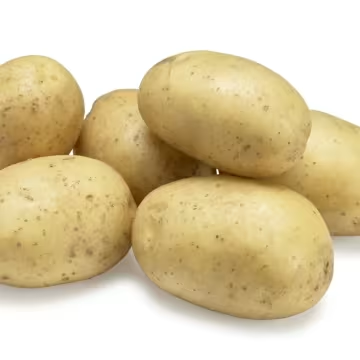
This pest affects a wide range of plants, including potatoes, tomatoes, cucumbers, carrots, and various leafy vegetables. It also poses a threat to lawns, golf courses, and young saplings in tree nurseries. Mole crickets are particularly destructive in moist, organic-rich soils where they can easily burrow and feed.
The life cycle of the mole cricket typically lasts from one to three years, depending on the environmental conditions. Both adults and nymphs overwinter deep in the soil. In late spring, females build subterranean nest chambers where they deposit batches of eggs. After hatching, the nymphs develop through several instars, feeding on roots and organic matter.
The damage caused by mole crickets is mainly due to their burrowing activity and feeding habits. They sever plant roots and stems just below the soil surface, causing plants to wilt and die suddenly. Their extensive tunneling also disturbs the soil structure, leading to poor plant growth and significant yield losses in infested areas.
- Deep autumn plowing to expose and destroy overwintering sites.
- Setting traps using manure or moist compost to attract and catch adults.
- Application of specialized insecticidal baits placed in the soil.
- Using biological control agents such as nematodes or entomopathogenic fungi.
- Frequent cultivation of soil between rows to disrupt existing tunnels.