
Bright-line Brown-eye
Rhyacia festiva
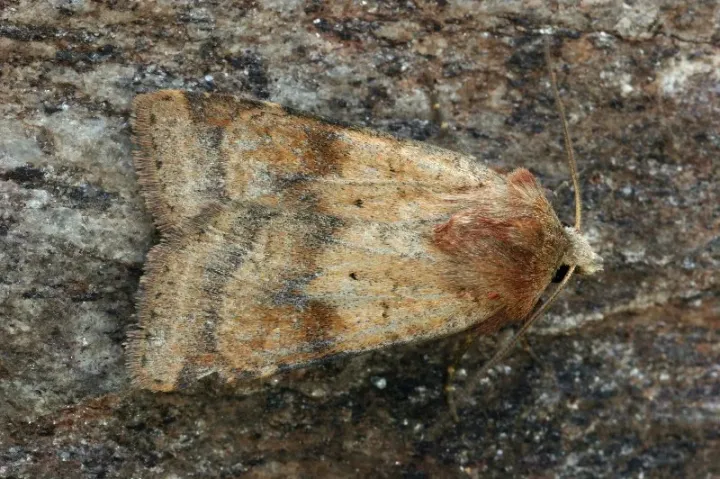
Description
How to identify
The Bright-line Brown-eye, Rhyacia festiva, is a moth species belonging to the Noctuidae family within the Lepidoptera order.
Adult moths typically have a wingspan ranging from 35 to 40 mm, with forewings showing a palette of earthy tones from grey to dark reddish-brown.
A distinctive feature of this species is the specific pattern on the forewings, which provides excellent camouflage against tree bark and dry vegetation.
The larvae are typically brownish or greenish-grey caterpillars with a sturdy body structure and a sclerotized head capsule adapted for chewing.
Identification in the field often relies on observing the larvae's movement patterns and their preference for nocturnal feeding on the host plants.
What it damages
This moth is a polyphagous pest, meaning it feeds on a wide range of plants, including sugar beets, cereals, and various horticultural crops.
Young larvae initially skeletonize the foliage, while older larvae consume the entire leaf blade, leading to severe defoliation of the crop.
In addition to leaf feeding, the larvae can cause significant damage by cutting through the stems of young plants at the soil surface level.
Heavy infestations can lead to substantial reductions in photosynthesis, ultimately stunting plant growth and decreasing total harvested yield.
The damage is particularly critical during the early stages of crop development, where even minor feeding can lead to plant mortality.
When it appears
The adult moth flight season generally occurs from June through August, peaking during warm summer nights across their primary distribution range.
The species completes its lifecycle in one or two generations per year, depending on the latitude and prevailing local climate conditions.
The larvae overwinter in the soil or under surface debris, remaining in a state of diapause until temperatures rise in the following spring.
Active feeding resumes in the spring, as the larvae emerge to forage on early-season weeds before transitioning to primary agricultural crops.
Pupation takes place in the soil, protected by a cocoon constructed from silk and soil particles, which shields the developing pupa from environmental stress.
Signs of infestation
Visible signs of infestation include irregular holes in the leaves and the presence of granular frass deposited on the foliage or at the base of the plant.
Sudden wilting or lodging of young crops often indicates subterranean feeding or the severing of the main stem by the larvae.
The presence of adults in light traps or pheromone monitoring stations during mid-summer confirms the activity of the pest in the vicinity.
Careful inspection of the leaf undersides, especially in the evening, may reveal egg batches, which are typically laid in small clusters.
Patches of sparse or dead vegetation in fields during the early growing season are often a tell-tale sign of previous larvae activity in that area.
Control measures
Effective management begins with deep soil tillage, which disturbs the pupation sites and exposes larvae to predators and unfavorable weather.
Maintaining clean fields by removing weed hosts is a crucial step, as it deprives the first larval instars of their initial food source.
Biological controls, such as the use of Bacillus thuringiensis or egg parasitoids like Trichogramma, offer sustainable alternatives to chemical sprays.
When economic thresholds are exceeded, targeted application of selective insecticides should be timed for the early evening to match pest activity.
- Implement crop rotation to break the pest cycle.
- Use light traps to monitor and reduce adult population density.
- Promote natural predator habitats around field edges.
Discussion
No discussions yet — be the first.