
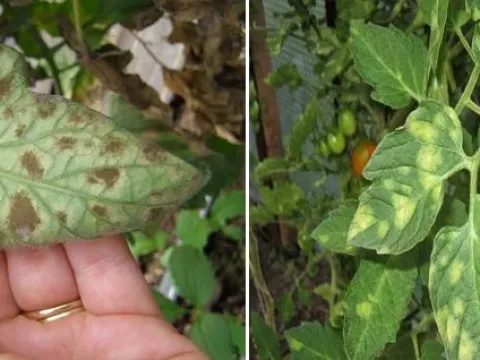
Tomato leaf mold
Fulvia fulva
Tomato leaf mold is caused by the fungus Fulvia fulva (synonym Cladosporium fulvum). This pathogen belongs to the kingdom Fungi, phylum Ascomycota, and is highly specialized in infecting solanaceous crops.
What the section contains
Tomato leaf mold
The fungus develops internally within the leaf tissue, with conidiophores emerging through stomata to release spores. This produces a characteristic velvety olive-brown mold, which is the hallmark of the infection.
Fulvia fulva is particularly persistent in greenhouse environments, where it can survive on structural surfaces, tools, and plant debris for several seasons, waiting for favorable conditions.
The pathogen is highly evolved to infect the genus Solanum. Its survival strategy involves forming conidia and sclerotia, allowing it to withstand harsh environmental stress.
Microscopic examination of the leaf underside reveals branched conidiophores arranged in clusters, which confirms the presence of the pathogen in diagnostic settings.
The primary host for this pathogen is the tomato plant. The disease causes significant damage by rapidly destroying the photosynthetic surface of the leaves, which is crucial for plant development.
As the disease progresses, leaves become necrotic and die. This loss of foliage limits the plant's ability to produce sugars, resulting in poor fruit development, smaller yields, and reduced quality of the produce.
In severe cases, the entire plant can lose its lower foliage, making it highly susceptible to secondary infections and environmental stress, ultimately leading to significant crop failure.
The economic impact on commercial greenhouse growers is substantial due to both direct harvest losses and the ongoing costs associated with repeated fungicide applications.
Unlike some other fungal diseases, leaf mold does not typically infect the fruit itself, but the drastic reduction in foliage health effectively stunts the overall production process.
The disease thrives in conditions of high humidity, typically above 80%, and warm temperatures ranging from 20 to 25 degrees Celsius. These conditions are commonly found in poorly ventilated greenhouses.
Outbreaks often occur during the flowering and fruit-setting stages, when the leaf canopy is dense and provides a microclimate that traps moisture against the leaf surface.
Poor irrigation management, such as splashing water onto leaves or creating excessive condensation, acts as a primary catalyst for the rapid spread of spores throughout the crop.
The pathogen's life cycle is quite fast; once the environmental conditions are met, the fungus can produce a new generation of spores within 10 to 14 days, leading to exponential spread.
While the disease is most common in protected environments, it can also appear in open fields during long periods of rainfall and moderate temperatures.
Symptoms initially appear on the underside of the leaves as pale green or yellowish spots that eventually darken to a distinct olive-brown, velvety appearance.
- Pale yellow spots on the upper leaf surface.
- Olive-green fuzzy growth on the lower leaf surface.
- Browning and necrosis of affected leaf tissue.
- Curling and wilting of the leaves in advanced stages.
- Premature leaf senescence and death starting from the lower canopy.
As the infection advances, the yellow spots on the top side become more defined, and the underside shows clear evidence of sporulation, appearing like patches of dark felt.
The disease usually moves upward from the lower canopy, as these leaves are exposed to higher humidity levels and less airflow, creating a gradient of infection from the bottom to the top.
Early detection is difficult, but diligent inspection of the lower leaf surfaces for the characteristic velvety spots allows for timely intervention before the disease covers the entire plant.
The primary control strategy is managing the greenhouse environment, specifically maintaining humidity levels below 70% and ensuring adequate air circulation to prevent leaf wetness.
Cultural practices are essential, including the removal and destruction of all infected plant materials and thorough sanitation of the greenhouse after the cropping season to eradicate overwintering spores.
Utilizing resistant or tolerant tomato cultivars is the most effective and sustainable long-term solution for managing leaf mold in both small and large-scale operations.
Chemical control can be achieved using fungicides, such as those based on copper, strobilurins, or triazoles, but these must be applied strictly according to label instructions and harvest intervals.
Improving plant spacing and using drip irrigation helps minimize leaf humidity, thereby creating an unfavorable environment for the establishment and spread of Fulvia fulva.