
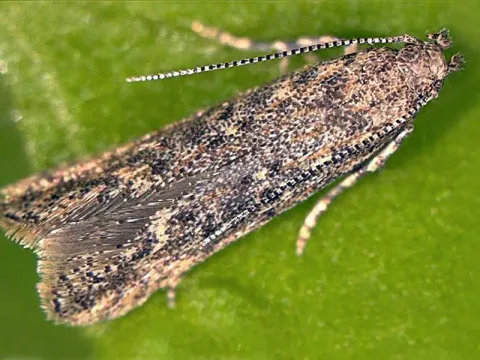
Tomato leafminer
Tojo
The tomato leafminer (Tuta absoluta) is a destructive micro-lepidopteran pest originating from South America, now spread globally.
What the section contains
Tomato leafminer
It belongs to the family Gelechiidae and is recognized as a major threat to both greenhouse and open-field tomato production.
The adult moth is approximately 6 mm long with a wingspan of 10 mm, characterized by a greyish-brown appearance with silvery scales.
Female moths lay over 250 eggs during their lifetime, primarily on the underside of tomato leaves or stems.
The larvae are highly active, feeding voraciously on mesophyll tissue, which is the primary cause of plant physiological stress.
The larvae mine the leaves, stems, and fruits, creating irregular gallery-shaped tunnels that cause severe tissue damage.
While tomatoes are the primary host, the moth also thrives on potato, eggplant, and various species of the Solanaceae family.
Fruit infestation is particularly detrimental, as it directly reduces the market value and facilitates entry for secondary pathogens.
Heavy infestations can lead to total crop loss if the pest population is not managed effectively during the early stages of development.
The pest is extremely difficult to eradicate once established due to its high reproductive rate and resistance to many standard insecticides.
Symptoms begin as small, pale, winding mines on leaves, which eventually turn necrotic and brown.
The presence of black frass pellets within the tunnels is a distinctive diagnostic indicator of Tuta absoluta infestation.
Fruit damage manifests as small entry holes, often accompanied by dark rotting areas caused by secondary infections.
Stems may also show signs of larval feeding, leading to structural weakness and stunted plant growth.
- Winding gallery mines on the leaf surface.
- Black frass deposits inside larval tunnels.
- Small circular entry holes on the fruit skin.
Integrated Pest Management (IPM) is the most effective approach, combining monitoring, biological, and chemical methods.
Pheromone traps are essential for early detection and population suppression by disrupting the mating cycle of adult males.
Biological control agents, such as predatory mirid bugs, are highly effective when introduced in controlled greenhouse environments.
Rigorous sanitation practices, including the removal and destruction of infested plant debris, significantly reduce the carry-over of pupae.
Chemical applications should be strictly targeted at the larval stage and rotated to prevent the development of pesticide resistance in the population.