


SKU #66346
·
32 views
Rubezh
Sorghum
Federal Agrarian Scientific Center of the South-EastUser rating
0 votes0% positive reviews
No ratings yet — be the first.
Direction
Grain, Silage
Grain; Color
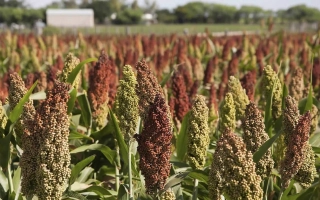
Dark Brown
Plant; height
180-200cm
Registration year
2020
About product

A stable, resilient sorghum variety engineered for consistent grain and high-quality silage production in arid regions.
Direction
Grain, Silage
Grain; Color
Dark Brown
Plant; height
180-200cm
Registration year
2020
Description
A Reliable Sorghum Variety for Challenging Climates
The «Rubezh» sorghum variety, developed by the Federal Agrarian Research Center (FANC) of the South-East, represents a robust breeding solution tailored for regions facing water scarcity and continental climate swings. Unlike many high-intensity hybrids that require optimal conditions to reach their potential, this variety is engineered for plasticity, maintaining consistent yields even under severe stress.
Agronomic Profile and Key Advantages
Standing at 180–200 cm, «Rubezh» produces significant biomass, making it an excellent dual-purpose choice for both grain production and high-energy silage. The characteristic dark-brown grain is a reliable indicator of proper physiological maturity and nutrient accumulation. A major competitive advantage is the variety's resistance to head smut, a fungal disease that can compromise fields where rotation cycles are tight or environmental conditions are favorable for pathogen development.
- Dual-Purpose Versatility: Equally effective for high-quality grain harvest and nutrient-dense silage production for livestock.
- Operational Efficiency: The plant's architecture (180–200 cm) is optimized for standard harvesting machinery, minimizing field losses.
- Integrated Protection: Strong genetic resistance to head smut reduces dependency on intensive fungicide programs, lowering overall input costs.
«Rubezh» is an ideal asset for agricultural enterprises looking for climate-resilient crop options. Developed by a dedicated team including V.V. Gusev and A.V. Khramov, this variety balances high yield potential with the hardiness required for unpredictable seasons. For farms focused on sustainable grain production or feed security, «Rubezh» serves as a stable hedge against environmental volatility.
Crop & resistance
Crop
Disease resistance
Specifications hover over for a hint about the specification
|
Direction
Direction
Existing varieties and types of cabbage are grown for fresh consumption, long-term storage, and technical processing. |
|
|---|---|
| Grain; Color | |
| Plant; height | 180-200cm |
| Registration year | 2020 |
| Catalog | Catalog → Sorghum |
| Manufacturer | Federal Agrarian Scientific Center of the South-East |
| Legal data |
Show · 8
|
| Country | Russia |
Store offers
Prices are updated on loadLoading offers…
Aggregator catalog: prices are collected automatically from store websites, normalized by AI and converted at the current exchange rate. Before ordering, confirm the price and availability on the store's website. This block is not indexed by search engines — the data is loaded after the page opens.
Not yet комментариев. Be the first!
Alternatives
Sorghum seeds · similar varieties




RSC CORAL
ФГБНУ Российский научно-исследовательский и проектно-технологический институт сорго и кукурузы
031 2 offers
0.31 € ≈ 16 ₴


See also
Often considered together with this variety



Recently viewed
Products you’ve viewed on this site
Reviews · 0