


SKU #67247
·
34 views
VITAMIN
Pumpkin
User rating
0 votes0% positive reviews
No ratings yet — be the first.
Plant Type
Unlimited Whip
Fruit; weight
5-8 kg
Laziness
Good
Registration year
1952
Store offers · 3 from 3 stores
Prices are updated on loadLoading offers…
Available at: Квіти Буковини · Сади Буковини · Веснодар · Yaskrava Klumba
Aggregator catalog: prices are collected automatically from store websites, normalized by AI and converted at the current exchange rate. Before ordering, confirm the price and availability on the store's website. This block is not indexed by search engines — the data is loaded after the page opens.
About product

Vitamin Pumpkin — a late-maturing large-fruited variety with a vegetation period of 110 to 130 days. The plant is characterized by a long-vining type with a main stem up to 6-6.5 meters long, dense foliage, and a well-developed root system. Successful growth requires plenty of free space, so planting denser than 4 plants per square meter is not recommended. Pumpkin prefers sunny areas with nutrien…
Plant Type
Unlimited Whip
Fruit; weight
5-8 kg
Laziness
Good
Registration year
1952
Description
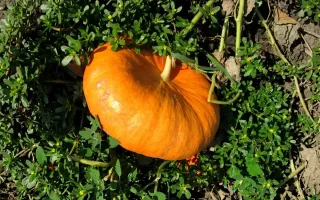
Vitamin Pumpkin — a late-maturing large-fruited variety with a vegetation period of 110 to 130 days. The plant is characterized by a long-vining type with a main stem up to 6-6.5 meters long, dense foliage, and a well-developed root system. Successful growth requires plenty of free space, so planting denser than 4 plants per square meter is not recommended. Pumpkin prefers sunny areas with nutrient-rich, slightly acidic soils and moderate moisture, and sowing should begin after the soil warms up to a temperature of no lower than +15°C. The plant is sensitive to frost but has good resistance to drought and diseases. The fruits have an oval or slightly flattened shape with a smooth, thin skin of rich orange color. Fruit weight varies from 4 to 8 kilograms, and pulp thickness reaches 10 cm. The pulp is tender, yellow, with pronounced sweetness and a pleasant aroma. High content of dry matter (8-11%), vitamins (C, A, B1, B2), carotene, pectin, folic acid, as well as micro- and macro-elements such as magnesium, potassium, and phosphorus, makes this variety particularly beneficial. Due to low caloric content and rich vitamin composition, Vitamin Pumpkin is widely used in dietetic and child nutrition. For cultivation, it is recommended to loosen the soil, water at the root, and apply mineral fertilizers, which promotes active formation of fruit set at high temperatures. Seeds can be sown using a seedling method or directly into the open ground, starting from mid-May. The plant requires a sunny and wind-protected location, as well as fertile, air-permeable soil with a neutral or slightly acidic reaction (pH 6-7). Yield reaches 3-5 kg per square meter, and fruits retain their taste qualities and attractive appearance for a long time, making the variety versatile for various types of heat treatment and fresh consumption.
Video · 4 videos
Suggest a video →Crop & resistance
Crop
Disease resistance
Specifications hover over for a hint about the specification
| Plant Type | |
|---|---|
|
Fruit; weight
Fruit; weight
Table watermelons weigh 0.6-16 kg. |
5-8 kg |
| Laziness | |
| Registration year | 1952 |
| Catalog | Catalog → Pumpkin |
| Legal data |
Show · 9
|
| Country | Russia |
Not yet комментариев. Be the first!
Alternatives
Pumpkin seeds · similar varieties





See also
Often considered together with this variety






Recently viewed
Products you’ve viewed on this site
Reviews · 0